In-House IT vs Managed Services: The Real Cost
Published June 6, 2026
For most small and mid-sized businesses, a managed provider costs less than an in-house hire once you count the full picture, even though the salary line alone makes hiring look cheaper. Most owners reach the same fork in the road. Either you hire someone to run IT, or you bring in a managed provider to do it. On the salary line, hiring usually looks like the cheaper option, and that is exactly why so many owners default to it. This post is for owners, office managers, and finance leads weighing that decision, and it walks through the real, fully loaded numbers so you can compare in-house IT vs managed services like for like instead of salary versus a monthly invoice.
The short version: a salary is only about 70 percent of what an internal technician actually costs, one person covers about a quarter of the week, and the tools that catch problems early are usually missing. Once you put the whole picture next to flat per-user pricing, the comparison looks very different.
The salary is about 70 percent of the real number
Start with a single Tier 1 help desk technician in Phoenix. Published salary data from Robert Half, Salary.com, ZipRecruiter, Glassdoor, and Indeed puts the band at roughly $46,000 to $64,000, with a midpoint around $50,000.
That base is not the real cost. Once you add payroll taxes, benefits, and paid time off, the fully loaded figure runs about 1.3 times the salary for a typical office role. The U.S. Bureau of Labor Statistics tracks this in its Employer Costs for Employee Compensation data, and benefits alone commonly add 25 to 35 percent on top of wages.
Run a $50,000 salary through that burden and you land near $65,000 a year, or roughly $5,400 a month, for one technician. And that is before recruiting and onboarding, which often add another $15,000 the first time you hire.
One hire covers a quarter of the week
A single technician works about 40 hours out of the 168 in a week. The other 128, including every night, weekend, and the stretch when they are out sick or on vacation, has no coverage at all.
Running a help desk around the clock is not one hire. Continuous coverage realistically needs three to six technicians once you account for shifts, which puts base labor alone north of $150,000 a year before a manager. Very few smaller companies can justify that, so in practice the in-house option means business-hours support and a gap the rest of the time.
The tooling gap is the one that hides
Here is the part the budget rarely shows. An internal desk usually has a low tool spend, often around $25 a month per technician for remote access and light ticketing. That looks like a saving. It is actually the gap.
A lean internal setup typically has no remote monitoring, no automated patching, and no professional ticketing system behind it. Published list pricing for that management stack shows it is a meaningful line item, and an in-house desk that skips it is not saving money so much as flying without instruments. The technician can fix what someone tells them about, but the issues that monitoring would have caught early stay invisible until they become your problem. A managed provider folds that tooling into the per-user price, which is why the comparison is rarely apples to apples.
Every ticket carries a cost
Each support request has a real, loaded cost. Service-desk benchmarks from MetricNet and HDI, cited by firms like ManageEngine and Supportbench, put a routine Tier 1 ticket around $22, desktop support around $70, and complex Tier 3 work around $104, with management overhead adding another 15 to 25 percent.
With an internal desk, a busy month is a more expensive month. With flat per-user managed services, tickets are folded into the rate, so the marginal cost of one more is effectively zero and volume never punishes you.
Side by side at 25 users
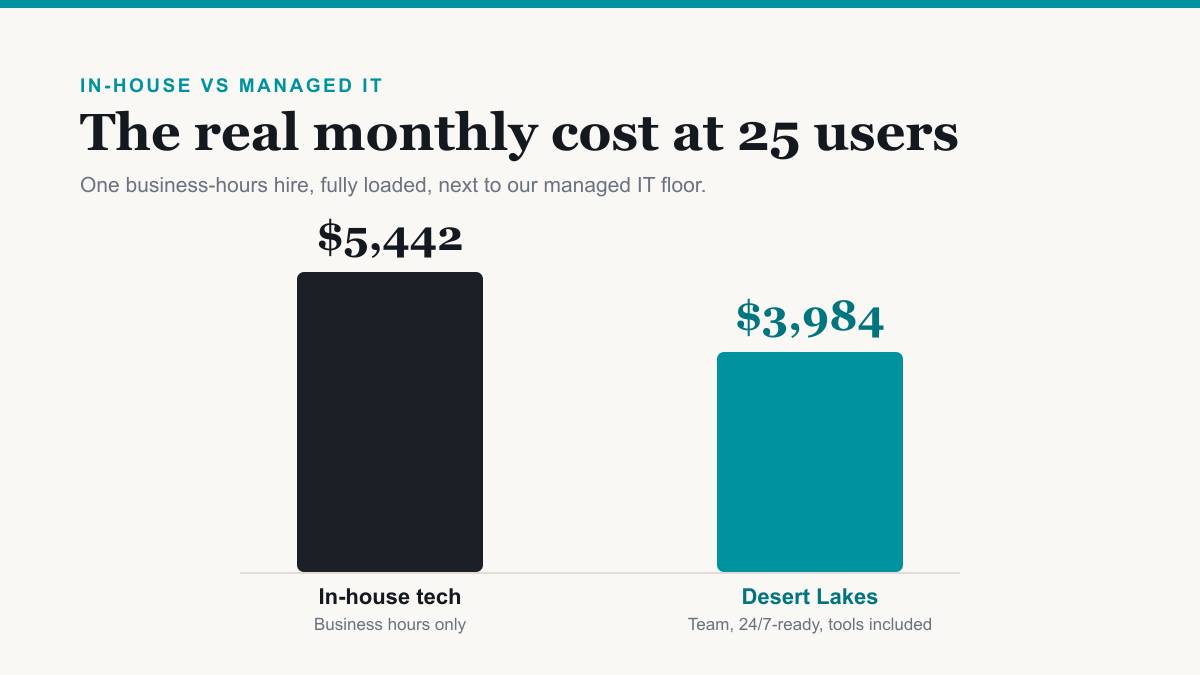
Put real numbers on it. One fully loaded in-house technician runs about $5,442 a month and covers business hours only. A managed IT floor bundle for a 25-person team comes in around $3,984 a month, with the monitoring and patching tools included and a whole team behind it instead of one person who can quit, get sick, or take a week off.
At larger headcounts, a lean in-house team can look cheaper on the salary line. That number, though, still assumes business-hours-only coverage, no after-hours, and none of the security tooling. We lay the full comparison out by team size, with sources, on our in-house vs managed IT page.
When hiring in-house does make sense
This is not an argument that hiring is always wrong. A dedicated internal person who knows your business, your people, and your quirks is genuinely valuable, especially for project work and the relationships that make IT feel less like a vendor. If you have steady, high-touch needs and the budget to staff for coverage, in-house has real merit.
What usually works best is not either-or. Co-managed IT keeps your internal person and adds the team, the tooling, and the security depth no single hire can run alone. Your person stops drowning in password resets and gets back to the work you actually hired them for, while the 2 a.m. alert and the compliance project have a team behind them. We cover how that pairing works on our managed services page.
What to actually compare
If you take one thing from this, let it be the checklist. When you weigh in-house against a managed provider, compare the fully loaded cost and not the salary, the hours of coverage and not just the headcount, whether the monitoring and patching tools are included or skipped, whether any real security comes attached, and what happens to your coverage the day that one person hands in their notice.
When you line those up honestly, flat per-user pricing tends to win on cost, coverage, and resilience at the same time. You can see exactly what that looks like for your team size on our pricing page, including a calculator.
Frequently asked questions
Is it cheaper to hire IT or outsource? On the salary line, hiring can look cheaper, but the salary is only about 70 percent of the real cost. Once burden, benefits, tooling, and the value of after-hours coverage are included, flat per-user managed IT is often less expensive and covers far more of the week.
What does an in-house IT person really cost? A Phoenix Tier 1 technician with a $50,000 salary costs roughly $65,000 a year fully loaded, about $5,400 a month, plus around $15,000 to recruit and onboard. That covers business hours only and excludes the monitoring and patching tools a managed provider includes.
Can we keep our IT person and still use a managed provider? Yes, and most of our clients do. Co-managed IT pairs your internal staff with our monitoring, security operations, and project depth, so your person handles the relationships and we cover the after-hours alerts and the heavier projects.
If you would like to see the real side-by-side for your business, Desert Lakes Solutions offers a no-pressure discovery call to walk through your current setup, your team size, and where the easy wins are. Book a discovery call.