How to Implement the NIST Cybersecurity Framework
Published July 5, 2026
To implement the NIST Cybersecurity Framework, you assess where your security program stands against its six core functions, decide where you need to be, close the gaps in priority order, and keep the whole thing documented as evidence you can show a customer, insurer, or auditor. It is voluntary guidance, not a certification or a law, which means you get to right-size it to your business rather than chase a pass-fail bar. This guide translates the framework into plain English and lays out a practical way to actually put it in place, written for the owner or operator who has heard "we should align to NIST" and wants to know what that involves.
What the framework is, in one paragraph
The NIST Cybersecurity Framework, or CSF, is a way to organize and prioritize your cybersecurity work, published by the National Institute of Standards and Technology. The current version, CSF 2.0, came out in early 2024 and is explicitly built for any organization, from the smallest nonprofit to the largest enterprise, in any sector. It does not tell you exactly which product to buy or setting to flip. It gives you a shared structure for deciding what matters, what you have, and what to do next. That is its strength: it is a framework for thinking clearly about risk, not a rigid checklist.
The six functions, in plain English
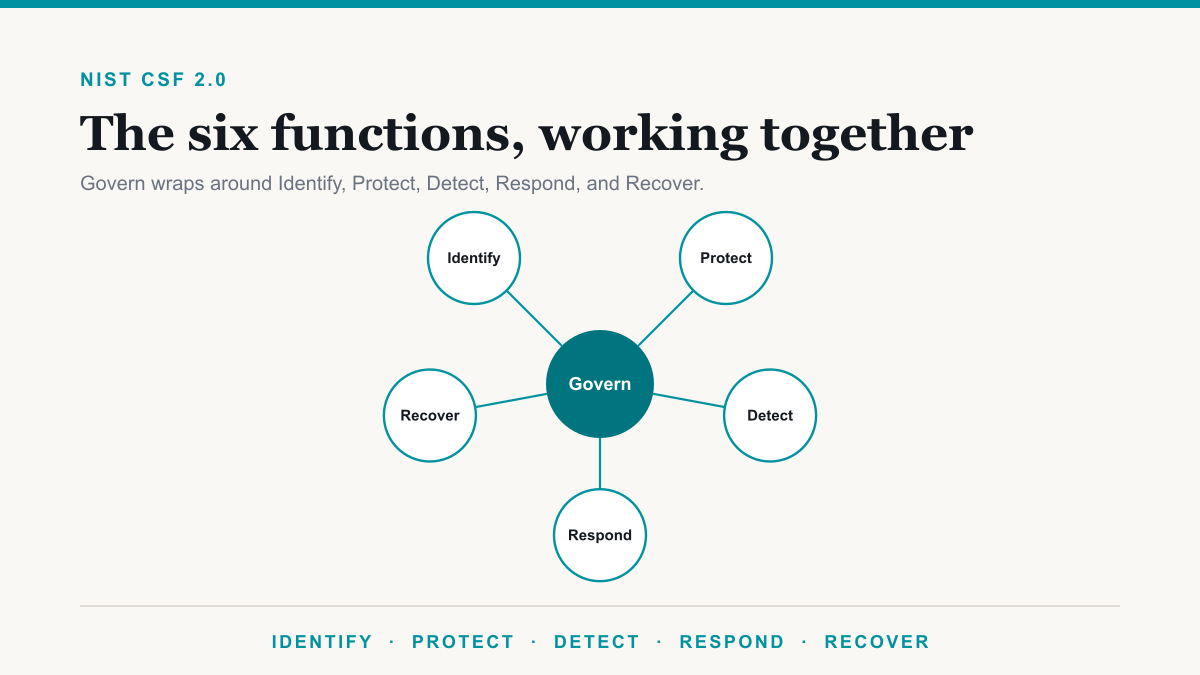
Everything in the framework hangs off six functions. Version 2.0 added the first one, Govern, to the original five, and that addition tells you something: NIST decided that leadership and accountability were as important as the technical controls. Here is what each one really asks:
| Function | The question it answers |
|---|---|
| Govern | Who is accountable for security here, what are our risk decisions, and what are our policies? (New in 2.0, and it wraps around the other five.) |
| Identify | What do we actually have, what data matters, and where is the risk? |
| Protect | What safeguards keep those things secure day to day? |
| Detect | How would we notice if something went wrong? |
| Respond | What do we do when something does go wrong? |
| Recover | How do we get back to normal, and what did we learn? |
Read top to bottom, those six questions are just a sensible way to run security. Most businesses are already doing pieces of all six informally. The framework's value is making that work deliberate, complete, and written down, so the gaps become visible instead of staying hidden until an incident finds them for you.
Profiles and tiers, without the jargon
Two framework terms are worth translating because they come up constantly. A profile is simply a snapshot: your current profile is where your security stands today, and your target profile is where you have decided it needs to be, based on your risks, your obligations, and your budget. The gap between them is your to-do list. Implementation tiers are a rough measure of how mature and formal your risk management is, from informal and reactive up to adaptive and continuous. You do not need to be the top tier. You need to be at the tier your business actually requires, which for most organizations is somewhere in the practical middle.
A realistic first ninety days
You do not implement the whole framework in one push. A sensible sequence looks like this:
- Scope it. Decide what is in: which systems, which data, which parts of the business. Trying to boil the ocean is the most common way these efforts stall.
- Build your current profile. Walk the six functions and honestly record what you do today. This is the gap assessment, and it is the most valuable single step, because you cannot fix what you have not named.
- Set your target profile. Decide where you need to be, driven by your real risks and any customer or insurance requirements, not by a desire to max out every control.
- Prioritize the gaps. Rank the difference between current and target by risk and effort. Do the high-risk, low-effort items first. Multi-factor authentication, tested backups, and access cleanup usually top the list.
- Build the evidence habit. As you close gaps, keep the proof: written policies, your target profile, records that controls are running. That evidence is what turns "we align to NIST" from a claim into something you can actually show.
NIST itself supports smaller organizations here with a free quick-start guide, which is a genuinely useful on-ramp. The framework overlaps heavily with the controls behind cyber insurance requirements and with day-to-day managed IT and security, so most of this work pays off in more than one place.
How CSF relates to 800-53, 800-171, and CMMC
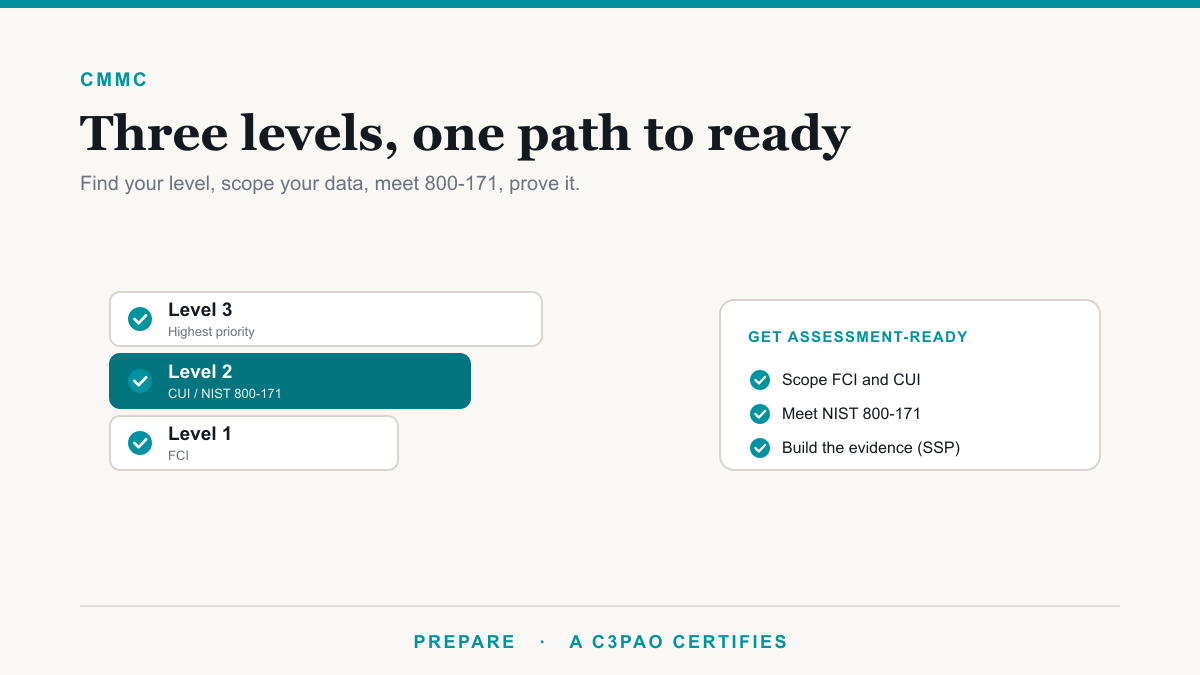
NIST publishes several things and the numbers blur together, so here is the clean version. The Cybersecurity Framework is the high-level outline you have been reading about: voluntary, for anyone, no certificate. NIST SP 800-53 is a large catalog of specific security controls, the reference library the framework can point into when you need control-level detail. NIST SP 800-171 is different in kind: it is a set of requirements that apply contractually when your business handles Controlled Unclassified Information for the federal government, and it is the technical backbone of CMMC.
That last distinction matters. The Cybersecurity Framework is a choice you make to run a better program. 800-171, through CMMC, is an obligation with a formal assessment behind it if you are in the defense supply chain. If that is you, the framework is still a good foundation, but the binding requirement is the other one, and we cover it in our guide to how to prepare for CMMC.
Frequently asked questions
Is the NIST Cybersecurity Framework mandatory?
No. The NIST Cybersecurity Framework is voluntary guidance that any organization can adopt to manage cybersecurity risk. It is not a law and not a certification. Some contracts, insurers, or customers may ask you to align with it, but NIST itself does not require or enforce anything.
What are the six functions of NIST CSF 2.0?
Govern, Identify, Protect, Detect, Respond, and Recover. Version 2.0, released in 2024, added Govern to the original five. Govern covers who is accountable, your risk decisions, and your policies, and it wraps around the other five functions rather than sitting beside them.
Can you get certified in the NIST Cybersecurity Framework?
Not in the way you get certified for something like CMMC. There is no official NIST CSF certificate for an organization. You implement it, document your target profile, and can show that work to a customer, insurer, or auditor as evidence, but there is no governing body that issues a CSF stamp of approval.
What is the difference between NIST CSF and NIST 800-53?
The Cybersecurity Framework is a high-level way to organize and prioritize your security program around six functions. NIST SP 800-53 is a detailed catalog of specific controls. Think of the framework as the outline and 800-53 as the deep reference library you pull specific controls from when you need them.
What is the difference between NIST CSF and NIST 800-171?
The Cybersecurity Framework is voluntary guidance any business can use. NIST SP 800-171 is a set of security requirements that apply contractually when you handle Controlled Unclassified Information for the federal government, and it is the basis of CMMC. One is a choice; the other is a contract obligation with an assessment behind it.
How long does it take to implement the NIST CSF, and where should we start?
Start with a gap assessment against the six functions and a written target profile, which takes a few weeks. Closing the gaps is the longer part and depends on your starting point, usually a few months of prioritized work. It is meant to be ongoing, not a one-time project with an end date.
Putting the NIST Cybersecurity Framework to work
Implementing the NIST Cybersecurity Framework is less about chasing a certificate and more about turning security from a scattered set of habits into a deliberate program you can see, prioritize, and prove. Start with an honest gap assessment against the six functions, set a target that fits your real risks, and build the evidence as you go. If you would like a hand getting from "we should align to NIST" to a documented current-and-target profile with a prioritized plan, Desert Lakes Solutions offers a no-pressure discovery call to walk through where you stand and what the practical next steps are. Book a discovery call and we will map it out with you.