Cyber Insurance Requirements: The IT Controls Insurers Expect
Published May 8, 2024, updated July 20, 2026
Cyber insurance requirements are a defined set of security controls you have to prove are in place before an insurer will issue or renew a policy: multi-factor authentication, endpoint protection, tested backups, and a handful of others. Meeting them largely determines whether you get covered, what you pay, and whether a claim actually gets paid when you need it. This guide is for owners and operators who want to understand what today's applications ask for, why insurers ask, and how to be ready without a last-minute scramble at renewal time.
Why insurers tightened the rules
For years, cyber insurance was easy to get and cheap. A short form and a check. Then ransomware turned into a multi-billion-dollar problem and claims costs surged across the industry. Their response was predictable: raise the bar. The application that used to be a formality is now a detailed questionnaire about your security posture, and the answers directly affect whether you are covered and what you pay.
The good news is that the controls insurers ask about are the same ones that genuinely reduce your risk. Meeting their requirements is not box-ticking. It is the security you should want anyway, and the policy is the reward for having it.
The cyber insurance requirements on almost every application
Requirements vary by insurer and by the size of your business, but the following come up on almost every application now.
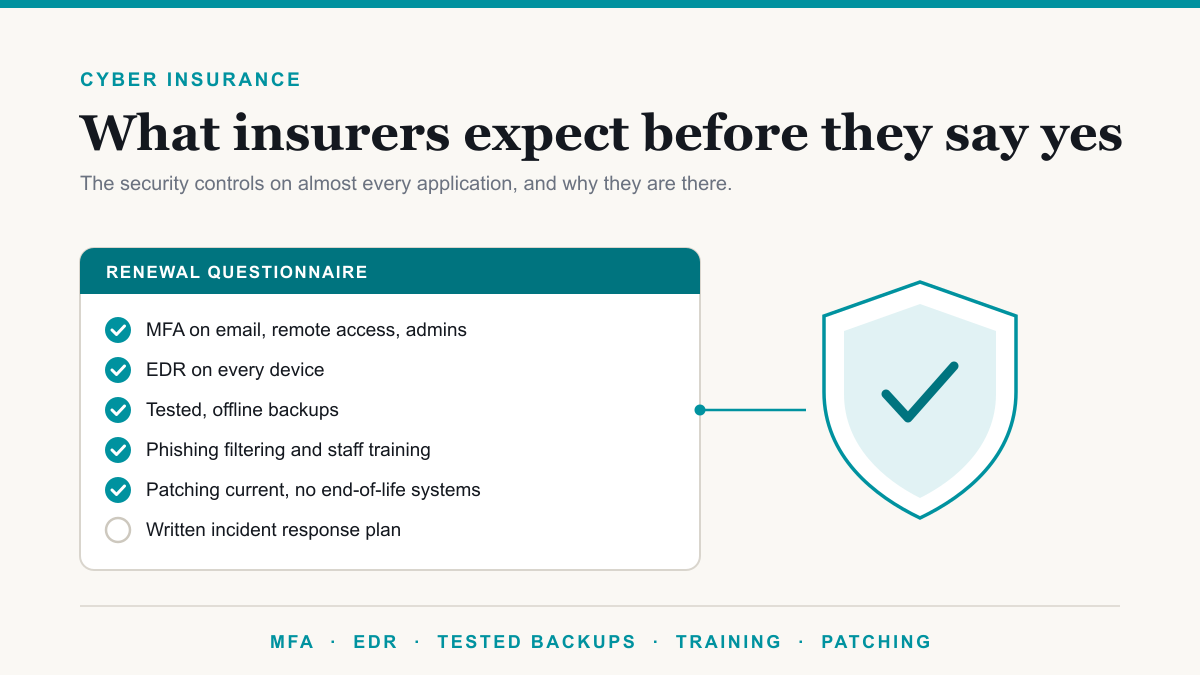
- Multi-factor authentication (MFA). This is the big one. Insurers want MFA, a second step beyond a password, on email, remote access, and administrator accounts. A stolen password alone should not be enough to get in. The U.S. cybersecurity agency, CISA, lists multi-factor authentication among its most important defenses, and insurers have made it effectively mandatory.
- Endpoint detection and response (EDR). Software on every computer that watches for signs of an attack and can stop it, rather than basic antivirus that only catches known threats. Insurers increasingly want EDR specifically.
- Tested, offline backups. Backups that are separated from your main network so ransomware cannot encrypt them too, and that you have actually restored from in a test. An untested backup is a guess, not a safety net. This is the heart of a real disaster recovery plan.
- Email security and phishing filtering. Most attacks start with an email. Insurers want to see filtering that blocks malicious messages before they reach your team.
- A maintained business-grade firewall. Applications regularly ask what sits at your network edge and whether it is actively kept up to date. A consumer router does not answer that question well. A properly configured and licensed Fortinet firewall for a growing practice does, and the maintenance part matters as much as the box.
- Security awareness training. Evidence that your staff are trained to spot phishing and handle data safely, since people are the most common way in.
- Patching and no end-of-life software. Systems kept up to date, and unsupported software (anything no longer receiving security updates) removed from the network.
- An incident response plan. A written plan for what you do when something goes wrong, so a breach is handled, not improvised.
- Access control and least privilege. People have access to what they need and no more, and former employees lose access promptly.
What a cyber insurance policy actually covers
It is worth being clear about what you are buying, because the policy is the other half of the equation. A typical cyber policy helps pay for the costs an incident leaves behind: forensic help to find and close the hole, restoring data and systems, legal fees, notifying affected customers, credit monitoring, public relations support, and the income you lose while you are down. Many policies also give you access to an experienced breach-response team, which matters more than most owners expect, because the first 48 hours after an incident are not the time to start looking for help. The FTC has a plain-language overview of what cyber insurance covers for practices and firms.
That is why the coverage matters even if your defenses are good. Prevention lowers the odds; insurance caps the damage. A business with both can take a bad week without it becoming an existential event. If your industry is regulated, HIPAA in healthcare being the obvious example, a policy can also help absorb the notification and legal obligations a data incident triggers.
What happens if you cannot answer yes
Insurers use your answers to decide three things: whether to cover you at all, how much to charge, and how much they will pay if you make a claim. Falling short on a key control like MFA can mean a higher premium, a lower coverage limit, a specific exclusion, or a flat decline. In a worst case, misstating your controls on the application can give an insurer grounds to deny a claim after an incident, which is the most expensive outcome of all.
That is why honesty on the application matters as much as the controls themselves. Answer for the security you actually have, then close the gaps.
How to get ready without the scramble
Most businesses discover these requirements a week before renewal, then panic. A calmer approach works better:
- Get the application early. Ask your broker for the security questionnaire well before renewal so you know what you will be asked.
- Run an honest gap assessment. Compare each requirement to what you actually have in place today. This is where a good IT partner earns its keep, because the questions are technical and the wrong answer is costly.
- Close the high-impact gaps first. MFA, EDR, and tested backups carry the most weight with insurers and do the most to reduce real risk, so start there.
- Document everything. Insurers want evidence, not assurances. Keep records that show the controls are running.
Much of this overlaps with the work behind frameworks like HIPAA and SOC 2, so if you are pursuing compliance you are already partway to an insurable security posture. The underlying security controls do double duty.
One more question that comes up: some carriers and brokers ask whether an outside party has tested your defenses. If that lands on your renewal, our dedicated Arizona penetration testing practice covers whether cyber insurance requires a penetration test and what a right-sized test looks like.
Choosing a policy that fits
Once the controls are in order, the policy itself deserves the same scrutiny. Three things are worth doing before you sign:
- Match coverage to your real risks. A practice that holds patient records has different exposure than a contractor with a big wire-transfer risk. Make sure the policy covers the incident types that would actually hurt you.
- Read the exclusions. Know what is not covered and what conditions, like maintaining the controls you attested to, the coverage depends on.
- Compare more than price. Claims handling, response speed, and the quality of the breach-response team matter when you are the one calling.
Frequently asked questions
What are the main cyber insurance requirements?
The most common requirements are multi-factor authentication on email and remote access, endpoint detection and response on every computer, tested and offline backups, a maintained business-grade firewall, email and phishing filtering, security awareness training, prompt patching, and a written incident response plan.
What does cyber insurance actually cover?
A typical policy helps pay for incident response and forensics, restoring data and systems, legal fees, notifying affected customers, credit monitoring, and lost income while you are down. Coverage varies by policy, so read what is included and excluded before you need it.
Why is cyber security insurance important?
Because even well-defended businesses can be hit, and recovery is expensive. A policy covers the costs a single incident can generate, from forensics to legal fees to downtime, so one bad week does not threaten the business. It backstops your security controls; it does not replace them.
Why do cyber insurers require multi-factor authentication?
Because stolen passwords are behind a huge share of breaches and ransomware. Multi-factor authentication means a password alone is not enough to log in, which blocks the most common attack path. Insurers have seen the claims data and now treat MFA as a baseline requirement.
Can I be denied cyber insurance?
Yes. If you cannot demonstrate the controls an insurer requires, you can be charged more, offered lower limits, given specific exclusions, or declined. Misrepresenting your controls can also give an insurer grounds to deny a claim later, so accuracy matters.
How long does it take to meet cyber insurance requirements?
It depends on where you start. Turning on multi-factor authentication can take days, while deploying endpoint protection, fixing backups, and training staff across a business can take a few weeks. Starting before renewal is the difference between a calm rollout and a scramble.
Meeting cyber insurance requirements without the drama
Cyber insurance requirements are really just a list of the security controls that stop the most common and most expensive attacks. Meeting them protects your business twice over: it reduces the chance of an incident, and it keeps your coverage in place and affordable when you need it. If a renewal questionnaire has you unsure where you stand, Desert Lakes Solutions offers a no-pressure discovery call to map your current controls against what insurers expect and lay out the path to readiness. Book a discovery call and we will help you get there.