LLM Hosting for Business: Azure, a Datacenter, or Your Own Hardware
Published August 28, 2026
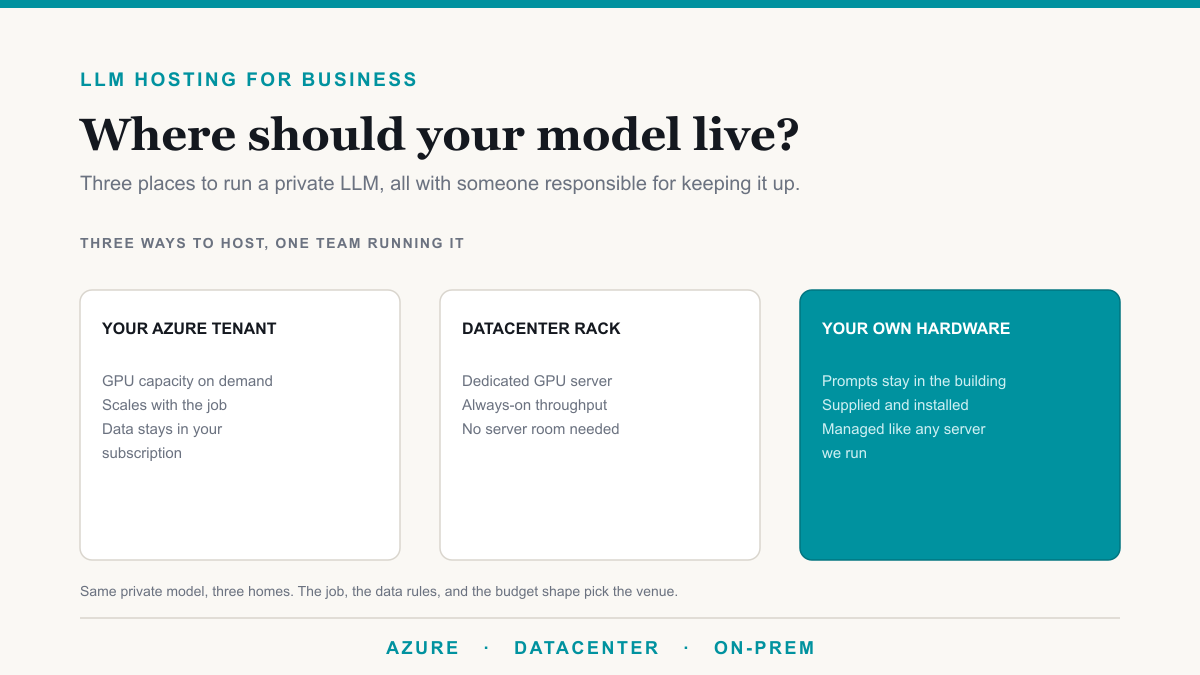
LLM hosting for business means running a private language model in one of three places: your own Azure tenant, a rack in a datacenter, or hardware in your office, with someone responsible for keeping it up. The outcome is a model you can point at work that should not go into a consumer chatbot, without making GPU upkeep a staff job. This is for owners and ops leads in healthcare, legal, finance, and professional services who want a private LLM hosted for them.
If the question is whether you should buy a GPU and run it yourself, that is a different article. We already wrote the DIY version: self-hosted LLMs for business. This page is the hosting question: where the model lives, and who keeps it up.
Why host your own LLM at all
Some work cannot go into a consumer assistant: patient notes, deal files, payroll, source code, a prompt that is the product. A private model runs that work without pasting it into someone else's chat window. For healthcare, HHS says a covered entity may use a cloud service for electronic protected health information if it has a business associate agreement with the cloud provider and otherwise follows the HIPAA Rules. That is in HHS guidance on HIPAA and cloud computing, checked August 25, 2026. Hosting puts the data path on a contract you can explain.
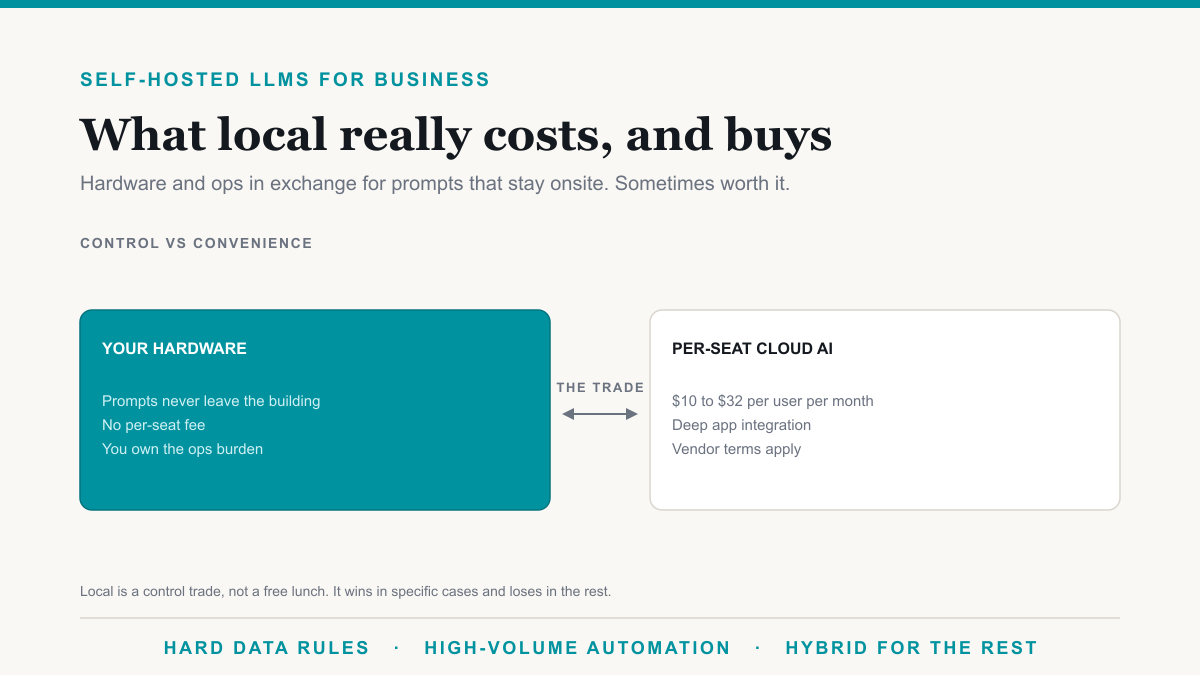
Volume is the other common reason. Per-seat pricing is a poor fit when the "user" is an automation running thousands of times a day. We already run local models in production as the supervisor on Playwright automation inside the client's environment. A hosted private LLM is the same class of job: a defined task, high repetition, a box that has to stay up. Staff still need help in Word and Outlook. That is a different product, covered below.
Option 1: Host an LLM in Azure
To host an LLM in Azure is to run the private model inside your own subscription, so billing, identity, and logs sit with you. Desert Lakes Solutions stands that up and keeps it running as part of managed IT. The usual shape is GPU virtual machines in that subscription: capacity you can size to the job and stop paying for when the job is idle.
Microsoft documents GPU-accelerated virtual machine families built for training and inference, including the NC and ND series, in its CUDA on Azure overview, checked August 25, 2026. Those machines live in your subscription. Azure bills them by usage. List prices move by series and region, so we quote the size you need.
Some shops want a private model endpoint in the same Azure account instead of administering a virtual machine. Microsoft's privacy documentation for Models sold by Azure, also checked August 25, 2026, states that prompts and completions are not available to other customers and are not used to train foundation models. Global deployment types may process inference in any Azure region where that model is deployed. Regional types keep processing in the region you chose.
Azure LLM hosting fits work that spikes, work you are still sizing, and shops that already live in Azure. It is a weaker fit if the requirement is that prompts never leave a building you can walk into.
Option 2: Private LLM hosting on a dedicated server in a datacenter
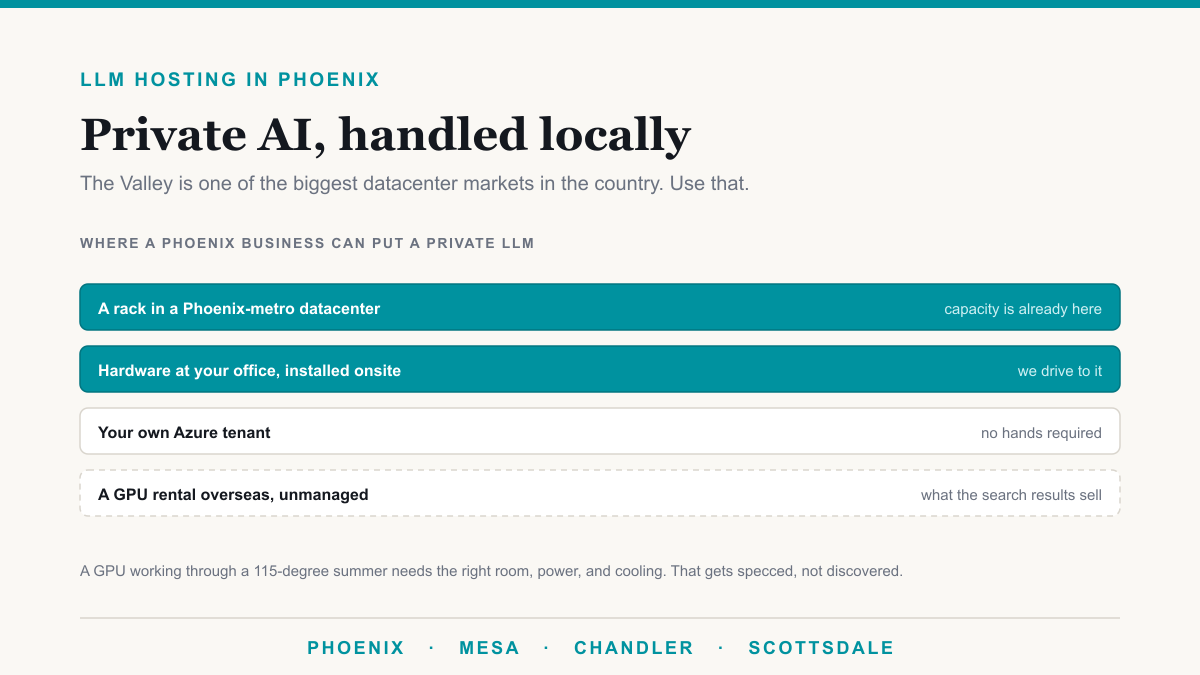
A dedicated server in a datacenter is a GPU box that stays on, in a building designed for power, cooling, and physical access, without you converting a closet into a server room. Managed LLM hosting, in this shape, means we keep that box patched, backed up, and reachable. You get always-on throughput, and the machine lives in the facility instead of your hallway. We do not publish a facility name here. The public fact is the pattern: a dedicated rack, a monthly bill, someone on the hook when the box is down.
Choose the datacenter option when the model has to stay up every business day, the office cannot take the heat and power, and you still want a physical machine rather than cloud VMs that scale to zero. If the workflow is on the same LAN as a scanner or an on-site system that cannot talk to the internet, read option 3.
Option 3: An on-premises LLM on hardware you own
On-premises LLM hosting puts the model on hardware in your building, so prompts never leave the office. Desert Lakes Solutions specs the machine, sells it, racks it, and manages it like any other server we run. You own the box. We keep it up. That is still hosting. You are not shopping cards and hoping the closet stays cool.
The model weights sit on a machine you can point at, under the access rules you already enforce on that network. You buy the hardware, then pay for electricity, cooling, and management. Exact cards change every few months, so we spec for the job rather than naming a SKU in a blog post.
On-premises fits hard rules that data cannot leave the building, air-gapped or tightly firewalled networks, and jobs that sit next to the system they automate. It is a poor fit if nobody has a room, a circuit, and cooling that can take a GPU that runs all day. In that case use the datacenter rack or Azure for the same private model.
How to choose
Lay the three options next to the job, the data rule, and the room you actually have. Use the row that actually constrains you: where the data goes, how the bill is shaped, or who can touch the box.
| Azure tenant | Datacenter rack | Your hardware | |
|---|---|---|---|
| Where the data goes | Your Azure subscription, in the region and deployment type you chose | A dedicated server in a datacenter, offsite from your office | A machine in your building; prompts stay on that network |
| Cost shape | Usage-based monthly: GPU hours and related Azure services | Fixed monthly for the rack, power, and management | Hardware purchase, then power, cooling, and management |
| Latency and throughput | Scales with the size you provision; you can grow or shrink | Always-on capacity you sized when you ordered the box | LAN-local; throughput is whatever GPU you bought |
| Who runs it | We run the subscription resources; Microsoft runs the datacenter under them | We run the server; the facility runs the building | We run the server in your office, including onsite hands when it needs them |
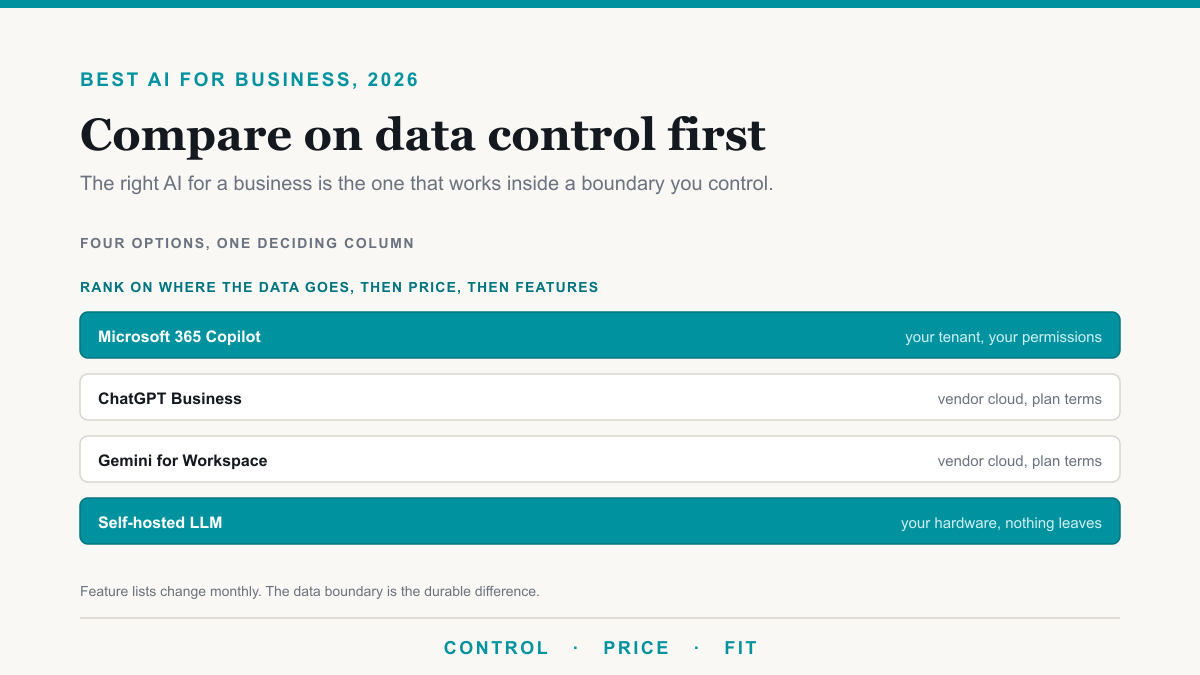
Plenty of businesses run Microsoft 365 Copilot for staff in Word and Outlook and a hosted private model where control matters, and the two work fine together. Copilot inherits the signed-in person's Microsoft 365 permissions. The hosted model sees what you send it. Those jobs sit next to each other, and you can run both.
What it costs
We are not publishing prices here. Cloud list rates and hardware SKUs move. Date that: August 25, 2026. The cost shape is what holds still.
- Azure. Usage-based. You pay for GPU hours and the surrounding services while they run. Idle capacity you shut off stops billing. Always-on jobs still pay for always-on hours.
- Datacenter. A fixed monthly bill: the server, the rack, power and cooling in the facility, and management. Predictable. You are paying for the box whether the model had a quiet Tuesday.
- On-premises. You buy the hardware, then pay to keep it powered, cool, and managed. The capital line is lumpy. The management line is monthly. Electricity is real.
A quote is the only honest number, because it has to match the model, the uptime, and the room. If you want that number against a workflow you already run, start with a discovery call.
Frequently asked questions
Can you host an LLM in Azure?
Yes. A private model can run in your Azure subscription as GPU virtual machines billed to that tenant, or as a private model endpoint in the same subscription. Identity, logs, and invoices stay with you. Capacity scales with the size you provision. We stand it up and keep it running so you are not administering GPU hosts yourself.
Is it better to host an LLM in the cloud or on premises?
It depends on the data rules, the workload, and whether you have a room that can handle the heat and power. Azure is usage-based and scales with the job. A datacenter rack is always-on without a server closet. Hardware in your office keeps prompts in the building. None of those three is automatically the right answer for every firm.
How much does LLM hosting cost for a business?
Azure is usage-based: you pay for GPU hours and related cloud services while they run. A datacenter rack is a fixed monthly bill. On-premises is a hardware purchase plus ongoing management. We do not publish a rate card here because cloud list prices and hardware SKUs move. Ask for a quote against the actual job.
Who maintains a hosted LLM?
The host does: patches, model updates, disks filling with weights, a failed fan, and noticing when the box is down. That is the difference between buying hosting and running a GPU yourself. On Azure the work covers the virtual machine, identity, and backups. On a rack or office box it is the same job as any other server we run.
LLM hosting for business is a venue decision
LLM hosting for business is choosing where the private model lives and who is awake when it dies: your Azure tenant, a datacenter rack, or hardware in your office. The data rule, the job, and the room pick the venue. If you want to walk through those three against a workflow you already have, Desert Lakes Solutions offers a no-pressure discovery call to map the job and the honest cost shape. Book a discovery call.