SOC 2 Compliance: What It Really Takes to Get Ready
Published June 2, 2026, updated June 12, 2026
SOC 2 compliance means having an independent report, issued by a licensed CPA firm, that confirms how well your company protects customer data, and getting ready for it is mostly about doing sensible security consistently and being able to prove it. This guide is for business owners and operations or IT leaders who keep hearing “are you SOC 2?” and want a clear, honest picture of what it actually takes: the controls, the tools, and the steps, without the jargon and the scare tactics. The reason it matters is simple. SOC 2 has quietly become the security checkbox that larger clients expect before they will trust you with their data, so readiness is really about keeping good deals from stalling.
What SOC 2 compliance actually means, and what it does not
SOC 2 is a report on how well your company protects customer data, based on a framework from the American Institute of CPAs. An independent licensed accounting firm, the auditor, examines your security controls and writes up their findings. That report is what you hand to a customer who asks. When people say “SOC 2 compliance,” that is the shorthand they mean: having a clean, current SOC 2 report you can show.
Here is the part people get wrong, and it matters. SOC 2 is not a certification you pass or a badge you buy. It is an attestation, which means an outside auditor gives their professional opinion on your controls. You do not become “SOC 2 certified,” you receive a SOC 2 report. Only a licensed CPA firm can issue that report. A partner like Desert Lakes helps you get ready for the exam and supports your controls year-round, but the report itself always comes from an independent auditor. Anyone who tells you they will “certify” you is worth a second look.
SOC 2 Type 1 versus Type 2
There are two versions, and the difference is simply time.
| SOC 2 Type 1 | SOC 2 Type 2 |
|---|---|
| Checks that your controls are designed properly at a single point in time | Checks that your controls actually worked over a period of time |
| A snapshot | A track record |
| Faster to reach | Carries more weight with customers |
Many companies start with a Type 1 to show progress quickly, then move to a Type 2, which observes your controls over a window that is commonly three to twelve months. Most larger customers ultimately want to see the Type 2, because it proves you do this consistently, not just on the day the auditor looked. If a prospect simply needs to see you are serious, a Type 1 can unblock the conversation while the Type 2 window runs.
The five Trust Services Criteria
SOC 2 is built on five areas the auditor can evaluate, known as the Trust Services Criteria. You do not have to include all of them. Security is required for every SOC 2, and you choose the others based on what you promise customers. The five, in plain terms:
- Security (required). Are your systems protected against unauthorized access? This is the foundation every report includes.
- Availability. Is your service up and running as promised? Relevant if customers depend on your uptime.
- Processing Integrity. Does your system process data completely and accurately? Important for anything that handles transactions or calculations.
- Confidentiality. Is sensitive information kept private and shared only as it should be?
- Privacy. Is personal information handled in line with your privacy commitments?
The official definitions live in the AICPA Trust Services Criteria, which is the authoritative source if you want the full detail. For most companies starting out, Security alone, sometimes with Availability and Confidentiality, is the right scope. Scoping tightly at the start keeps the first report achievable, and you can widen it later as customers ask for more.
The SOC 2 readiness assessment: where it starts
Almost every successful SOC 2 effort begins with a readiness assessment, sometimes called a gap assessment. It is an honest look at where you stand today versus what SOC 2 expects, so you know exactly what to fix before an auditor is ever involved. Skipping this step is the most common way companies waste money: they walk into a formal audit unprepared, the auditor finds gaps, and the process stalls.
A good readiness assessment does three things. It maps your current controls against the Trust Services Criteria you have chosen. It produces a prioritized list of gaps, the things that are missing or not yet documented. And it gives you a realistic plan and timeline to close them. Done well, it turns a vague worry (“are we ready?”) into a concrete checklist. This is also the natural point to bring in a partner, because the gaps it surfaces are usually a mix of security work and documentation work that an experienced team can move through quickly.
What it actually takes: the controls
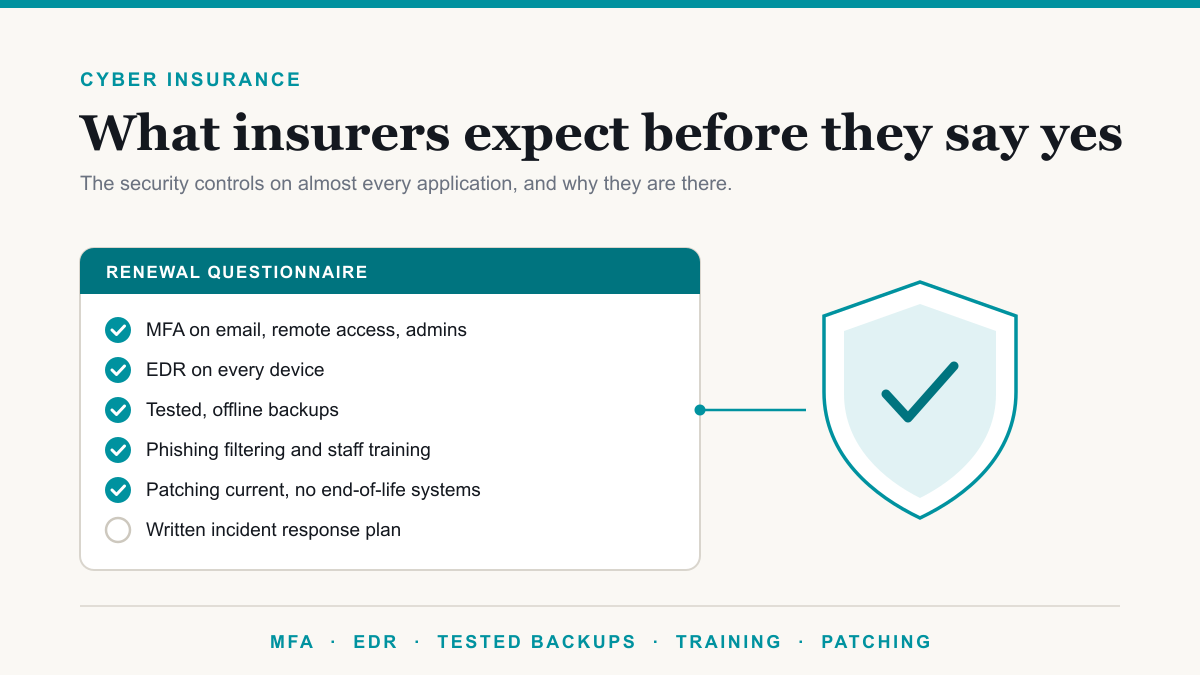
This is where most of the effort lives, and it all happens before the auditor ever shows up. From the gap assessment, readiness comes down to putting solid security practices in place and being able to prove they are running. The common pieces:
- Access control and multi-factor login. The right people get into the right systems, and a stolen password alone is not enough to get in.
- Encryption. Protecting data both while it is stored and while it travels.
- Change management. A tracked, reviewed process for making changes to your systems, so nothing slips through unchecked.
- Monitoring and logging. Keeping records of what happens in your systems so unusual activity gets noticed.
- Vendor management. Keeping tabs on the outside services that touch your data.
- Risk assessment and incident response. Knowing your risks and having a plan for when something goes wrong.
- Backups. Tested copies of your data so you can recover from a failure or attack.
- Security awareness training. Your team learning to spot phishing and handle data safely.
- Written policies and evidence. Documented rules for how you operate, plus proof you actually follow them.
SOC 2 is not about doing something dramatic once. It is about doing sensible security consistently, and being able to show it.
Several of these controls also do double duty. Strong access control, encryption, and data loss prevention satisfy SOC 2 evidence and protect you day to day. If you run on Microsoft 365, much of that confidentiality work can live in tools you already pay for, which we cover in our guide to data loss prevention with Microsoft Purview.
The tools that make it manageable
Collecting evidence by hand is the part that wears teams down, so most companies lean on a compliance automation platform. Tools like Vanta, Drata, and Secureframe connect to the systems you already use, gather the evidence the auditor wants automatically, and keep an eye on your controls continuously, flagging anything that drifts out of line. They turn a frantic, manual scramble into a steady dashboard.
Underneath that platform sit the security tools that actually do the protecting. Most SOC 2 programs rely on a familiar set: single sign-on and multi-factor login to control access, endpoint management and protection to keep laptops secure (the software that watches each computer for signs of trouble), logging to record activity, a password manager for the team, and regular vulnerability scanning to catch weak spots. You likely already have some of these. Readiness is often about tightening and documenting what you have, not buying everything new, which is exactly the kind of thing a steady managed IT program keeps in order for you.
What SOC 2 compliance costs, honestly
Cost is the question everyone wants answered and the one with the least tidy answer, because it depends heavily on your size, your scope, and where you are starting from. Rather than a single number, it helps to see the three buckets the spend falls into:
- Readiness work. The time and effort to close gaps, stand up controls, and write your policies. This is usually the largest piece for a first report, and it is where a partner saves you the most.
- The audit fee. What you pay the independent CPA firm to examine your controls and issue the report. This is a separate, recurring cost, since most companies renew their Type 2 each year.
- Tooling. The compliance automation platform and the underlying security tools. Some of this you may already own.
The honest framing is that SOC 2 is an ongoing program, not a one-time fee. The first report costs the most because you are building the foundation; renewals are lighter once the controls and evidence are running smoothly. If you want help estimating where your costs would land, our broader compliance support is built around getting you ready efficiently rather than over-buying.
SOC 2 versus HIPAA, ISO 27001, and the others
SOC 2 rarely lives alone. Many companies face more than one framework, and they overlap more than they differ. A few quick distinctions so you know what a customer is really asking for:
- SOC 2 vs ISO 27001. SOC 2 is a US attestation report from a CPA firm; ISO 27001 is an international certification of your security management system from an accredited body. US customers usually ask for SOC 2, while international or enterprise buyers may want ISO 27001. The underlying controls overlap heavily.
- SOC 2 vs HIPAA. HIPAA is a healthcare law with required safeguards for protected health information; SOC 2 is a voluntary, customer-driven report. If you handle health data, you may end up addressing both, and the security controls feed each other.
- SOC 2 vs PCI and CMMC. PCI applies if you handle card payments; CMMC applies if you work in the defense supply chain. Each is its own framework, but the core security hygiene SOC 2 asks for is a strong head start on all of them.
The good news is that the work is cumulative. The access control, encryption, monitoring, and documentation you build for SOC 2 compliance carry over, so the second framework is almost always easier than the first.
A realistic timeline, and where a partner helps
Honest expectations help. Readiness work, closing the gaps and getting your controls and evidence in order, often takes a few weeks to a few months depending on where you start. A Type 1 can follow fairly soon after. A Type 2 then observes your controls over a period that is commonly three to twelve months before the report is issued. So from a standing start, a solid Type 2 is usually a months-long effort, not a weekend project.
That is the stretch where a readiness partner earns its keep. Desert Lakes helps you run the gap assessment, put the right controls and tools in place, and keep the evidence flowing, so when the independent auditor arrives, the hard part is already done. The audit and the report stay with the CPA firm, which is exactly how it should be.
Frequently asked questions
What is SOC 2 compliance?
SOC 2 compliance means a company has an independent report on how well it protects customer data, based on an AICPA framework. A licensed CPA firm examines your security controls and issues the report, which you can share with customers who need assurance that their data is safe with you.
Is SOC 2 a certification?
No. SOC 2 is an attestation, not a certification. An independent auditor gives a professional opinion on your controls and issues a report. You do not become “SOC 2 certified,” you receive a SOC 2 report, and only a licensed CPA firm can issue it. Be cautious of anyone who offers to certify you.
How long does it take to get SOC 2 compliant?
It varies. Readiness work often takes a few weeks to a few months, and a SOC 2 Type 2 then observes your controls over a window commonly between three and twelve months. From a standing start, plan for a months-long effort rather than a quick turnaround.
How much does SOC 2 compliance cost?
Cost falls into three buckets: the readiness work to get your controls in order, the audit fee paid to the independent CPA firm, and the tools that collect evidence and do the protecting. Totals vary widely by company size and scope, so treat SOC 2 as an ongoing program rather than a one-time fee.
What is the difference between SOC 2 and ISO 27001?
Both prove you manage security well, but SOC 2 is a US attestation report issued by a CPA firm against the Trust Services Criteria, while ISO 27001 is an international certification of your information security management system issued by an accredited body. US customers usually ask for SOC 2; international or enterprise buyers may ask for ISO 27001.
Does a growing company need SOC 2?
Not by law, but increasingly by sales pressure. If you handle other companies' data, especially as a software or service provider, larger customers will often require a SOC 2 report before they sign. For many growing businesses, SOC 2 readiness is really about keeping good deals from stalling.
The bottom line on SOC 2 compliance
SOC 2 compliance comes down to doing sensible security consistently and being able to prove it, then letting an independent auditor confirm it. Once you understand the criteria, line up the right controls and tools, and keep your evidence in order, what felt like a roadblock to closing deals becomes a straightforward, repeatable process. The work is real, but it is very doable with a clear plan.
If customers are starting to ask for your SOC 2 report, Desert Lakes Solutions offers a no-pressure discovery call to look at where you stand and map out the path to readiness. Book a discovery call and we will help you get there.