What a Penetration Test Is and When You Need One
Published April 13, 2024, updated August 4, 2026

A penetration test is a controlled attack on your own systems, carried out by a security professional you hired, to find the weaknesses a real attacker would use before one does. The point is practical: you get a written list of the ways someone could get into your network, ranked by how bad each one is, so the fixes happen on your schedule instead of an attacker's. This post is for practice owners and office administrators who keep seeing the term on insurance paperwork and client questionnaires and want a plain answer on what a test involves and whether they need one.
What a penetration test is, and what it is not
The most common confusion is between a penetration test and a vulnerability scan, and the two are priced and sold very differently. A vulnerability scan is automated software that checks your systems against a database of known weaknesses and prints a list. It is inexpensive, it runs in hours, and it is worth doing regularly. A penetration test adds the thing a scanner cannot do: a human being who takes those weaknesses and tries to chain them together into actual access, the way an attacker would. The scan tells you a door was left open. The test walks through it and documents what was reachable on the other side.
A test is also not a substitute for day-to-day security. It is a periodic check on whether the protections you already pay for, the firewall, the endpoint protection, the sign-in rules, hold up when someone competent pushes on them. If nobody is watching your environment between tests, the test mostly confirms that. The ongoing monitoring and response side is a separate job, and the two work best together.
What actually happens during a test
Every legitimate test starts with scoping and written authorization. You and the tester agree on what is in bounds, what is off limits, when testing happens, and who to call if something looks wrong. Nothing starts until that is signed. Most external testing is invisible to your staff, and anything with real potential to interrupt work only happens with your explicit approval.
The test itself follows a sequence that NIST, the federal standards body, describes in its technical guide to security testing: planning, discovery, attack, and reporting. In plain terms, the tester maps what you have exposed, finds the weak points, attempts to use them, and writes down exactly what worked.
Two flavors matter:
- External testing looks at what is reachable from the internet: your firewall, remote access, email, anything with a public address. It answers the question of what a stranger anywhere in the world could do to you.
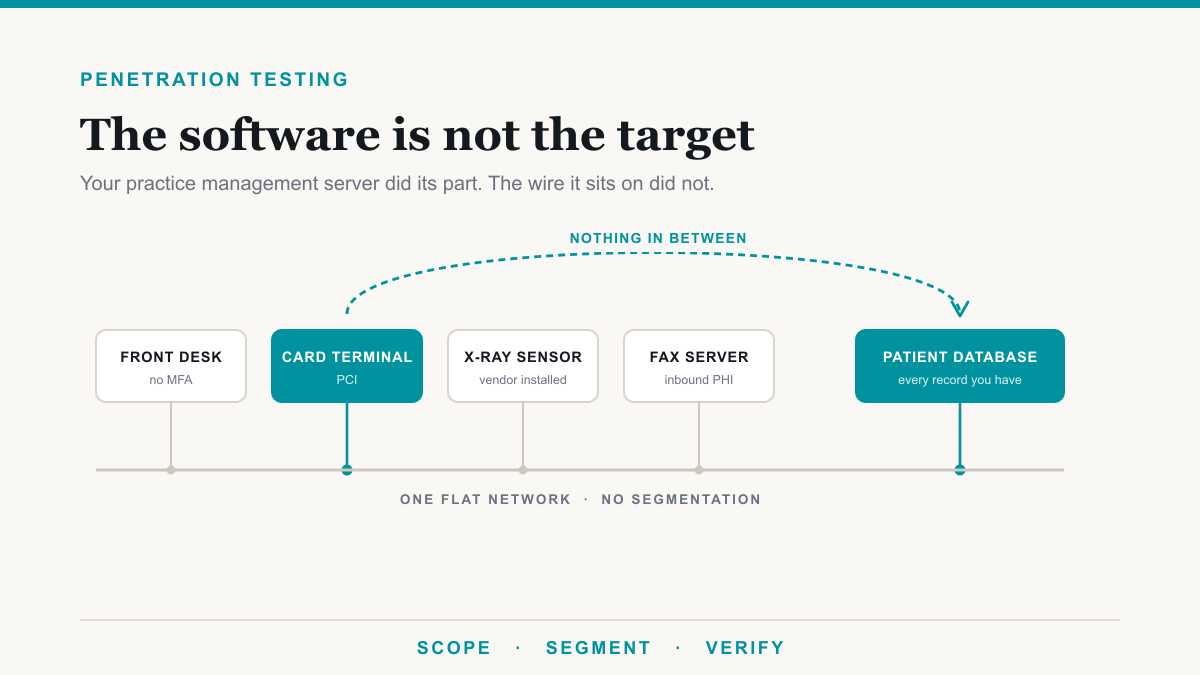
- Internal testing starts from inside the network, simulating an employee laptop that has already been compromised by a phishing email. It answers the more uncomfortable question of how far someone can get once they are in. For most companies, the first honest answer is further than anyone expected.
When a business genuinely needs one
Not every business needs a test this quarter, and a vendor who says otherwise is selling. These are the situations where one is genuinely called for.
A rule or a contract names it. If you take card payments, PCI DSS, the card industry's security standard, requires internal and external penetration testing at least once every 12 months for the systems that touch card data. HIPAA does not use the words "penetration test," but the Security Rule does require a periodic technical evaluation of your safeguards, and a test is one of the accepted ways to produce that evidence. Larger clients increasingly send security questionnaires that ask the question directly. When these obligations start stacking up, they belong inside a compliance program rather than being handled one deadline at a time.
Your cyber insurance renewal asks. Carriers have tightened underwriting, and renewal questionnaires now commonly ask whether you run security testing and what you did with the findings. A recent test with documented fixes can support better terms. Answering inaccurately can give a carrier grounds to dispute a claim later, which is the worst possible moment to find out.
Something significant changed. A new office, a migration to the cloud, a new practice management or case management system, a merger. Each of these redraws your network, and the last test described the old one.
You have never been tested and you hold data worth stealing. Patient records, client trust accounts, financial data. If your defenses have never been tried by a person, their condition is unknown, and unknown is not the same as fine.
One honest caveat: if the basics are not in place yet, multi-factor authentication, patching, working backups, a test will mostly tell you what you already know. Fix the fundamentals first, then use a test to verify them. It is a better use of the same money.
What you get back, and what to do with it
The deliverable is a report: what the tester found, how they got in, what each finding means for your business, and what to fix in what order. A good one reads like a repair list, not a trophy. The severity rankings are the useful part, because no company fixes everything at once, and the report tells you which two or three items close the paths that actually led somewhere.
The test only pays for itself if the fixes happen. Budget for remediation when you budget for the test, and ask up front whether a retest of the fixed items is included, because verifying the fix is the point.
One buying tip: ask any prospective tester whether a human attempts exploitation, or whether the deliverable is a formatted scan report. Both products exist, both get called penetration testing, and only one of them is.
Frequently asked questions
What is the difference between a vulnerability scan and a penetration test?
A vulnerability scan is automated software that lists known weaknesses, and it is cheap enough to run monthly. A penetration test adds a human who tries to chain those weaknesses together and actually get in, the way an attacker would. The scan tells you what is open, the test tells you what it costs you.
How often should a company get a penetration test?
Annually is the working standard, and it is what PCI DSS requires of businesses that handle card data. Beyond the calendar, test after any significant change: a new office, a move to the cloud, a new line-of-business system, or a merger. An old report describes a network that no longer exists.
Is penetration testing required for HIPAA compliance?
HIPAA does not name penetration testing specifically. The Security Rule requires a periodic technical evaluation of your safeguards, and a penetration test is one of the accepted ways to satisfy that. For a practice that has never had its defenses tested by a person, it is the most direct evidence available.
Does cyber insurance require a penetration test?
Increasingly, yes, or at least it asks. Renewal questionnaires now commonly ask whether you run security testing and what you did with the findings. A recent test with documented fixes can support better terms, and answering a questionnaire inaccurately can give a carrier grounds to dispute a claim later.
Will a penetration test disrupt our business?
It should not, and this is settled during scoping. You agree on what gets tested, when, and what is off limits before anything starts. Most external testing is invisible to staff. Anything with real disruption potential, such as testing during business hours on production systems, only happens if you approved it.
Where penetration testing fits for your business
A penetration test is a periodic check on a security program, not a replacement for one. The businesses that get the most from it treat the report as a work order: fix the findings, verify the fixes, and walk into the next insurance renewal or client questionnaire with evidence instead of assurances. Our penetration testing page covers how an engagement is scoped, and dedicated Arizona engagements run through azpentest, our specialist testing practice.
If you would like a plain read on whether a test makes sense for your practice this year, or whether the money is better spent on fundamentals first, Desert Lakes Solutions offers a no-pressure discovery call to look at what you have and tell you honestly. Book a discovery call.