5 Benefits of Attack Simulations for Your Business
Published February 15, 2024, updated August 4, 2026

The five real benefits of running attack simulations are proof that your defenses actually work, a fix list ordered by real risk instead of scanner scores, evidence you can hand to a compliance auditor or cyber insurer, staff who have seen a phishing attempt before one counts, and an incident response you have rehearsed instead of imagined. An attack simulation is a controlled exercise where a security professional safely plays the attacker against your own systems and people. This post explains what these exercises look like in practice, for owners and office administrators.
What an attack simulation actually is
The term covers a few different exercises, and it helps to know which one somebody is proposing before you agree to pay for it.
- A phishing simulation sends convincing but harmless fake phishing emails to your own staff. Anyone who clicks gets a short teaching moment instead of a compromised account. This tests people, not technology; our dedicated pentest practice runs them as managed phishing and social engineering campaigns.
- A penetration test is a person actively probing your network, applications, or Microsoft 365 tenant for weaknesses an attacker could use, then writing up what they found and how they got in. It is the most technical of the three and the one most often required by compliance frameworks. It is also the core of our security testing work.
- A tabletop exercise is a structured talk-through of an incident scenario, such as ransomware or payroll email fraud, with the people who would have to respond. Nothing technical is touched. The exercise finds out whether anyone knows who to call, where the backups are, and who is allowed to make decisions.
All three share the same logic: it is better to fail a test you scheduled than one an attacker schedules for you.
1. You find out what actually works
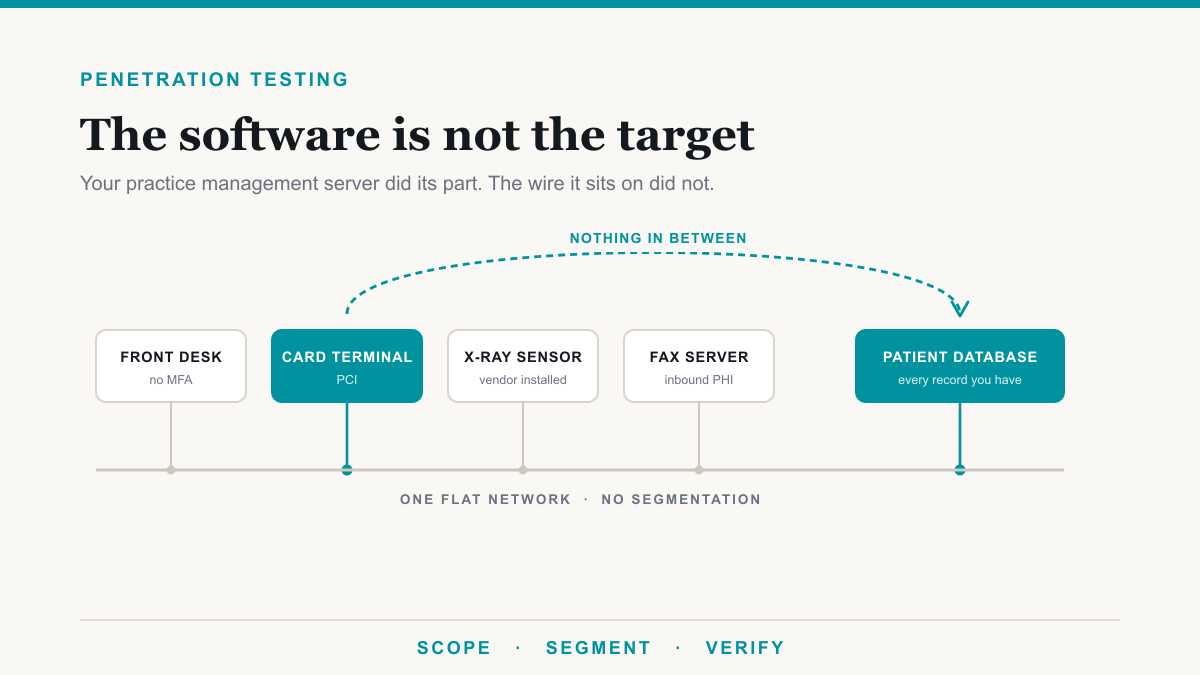
Every business has a gap between security as configured and security as it behaves. Endpoint protection that never got installed on two machines, a firewall rule left open after a vendor visit, multifactor authentication that covers email but not the remote-access tool. None of that shows up in a settings review, because on paper everything is turned on. A simulation finds it, because the tester goes where an attacker would go.
That evidence changes conversations. "We should be fine" becomes "the tester reached the practice management system starting from one phishing click, and here are the two changes that would have stopped it." Only one of those statements leads to action.
2. A fix list ordered by what an attacker would do first
Automated vulnerability scanners produce long reports, and much of what they flag does not matter in your specific environment. A simulation produces something shorter and more useful: the actual path an attacker would take through your setup, and the handful of fixes that break that path. Knowing which five things to fix first is worth more than a list of five hundred ranked by a formula.
3. Evidence for compliance and cyber insurance
If your business handles patient data, the HIPAA Security Rule requires a periodic technical and nontechnical evaluation of your safeguards, and a documented attack simulation is strong evidence of one. Card-payment rules expect regular testing as well, and cyber insurance applications increasingly ask outright whether you run penetration tests or phishing training. The answer can affect your premium, and sometimes whether you get coverage at all.
The report is the deliverable here. A simulation without a written report and a dated fix list proves nothing a year later. If your practice sits under HIPAA, PCI, or an insurer's questionnaire, that paperwork belongs in the same folder as your policies, and keeping that folder honest is a large part of our compliance work.
4. Staff who have seen the attack before it counts
Most incidents start with a person clicking a bad link, before the firewall ever gets tested. Phishing simulations work because the lesson arrives at the moment it matters: someone clicks, and instead of a breach there is a short explanation of what gave the email away. Run a few times a year, with no shaming attached, click rates tend to fall and reporting rates tend to rise. An office where staff forward suspicious emails to IT within minutes is safer than one with a perfect firewall and quiet employees.
If you run Microsoft 365, there is a licensing detail worth knowing. Microsoft's built-in attack simulation training requires Microsoft Defender for Office 365 Plan 2, which comes with Microsoft 365 E5 or as an add-on. It is not included in Business Premium. That alone is not a reason to upgrade the tenant, because a managed security partner can run equivalent campaigns with third-party tools.
5. A response you have rehearsed
The first hour of a real incident is a bad time to learn that nobody knows who can take the network offline, whether the backups are reachable, or what your cyber policy requires before anyone touches anything. A tabletop exercise surfaces all of that in a conference room instead.
Simulations also test the technical side of response: whether alerts actually fire, and whether anyone is watching when they do. If a tester can work inside your environment for days without anything noticing, that silence is itself the finding, and it is why detection and response coverage, the kind our security services provide, matters as much as prevention.
What a sensible cadence looks like
You do not need a red team on retainer. A pattern that fits most small practices is a penetration test once a year, phishing simulations spread through the year rather than one annual blast everyone warns each other about, and a tabletop exercise annually, ideally near your insurance renewal so the questionnaire answers are fresh and true. Repetition matters more than intensity. A single test tells you how things stood on one day; a rhythm of tests tells you whether you are getting better.
One habit separates businesses that get value from this from businesses that collect PDFs: budget time and money for the fixes before you commission the test. Findings that sit unread are an expense. The same findings, worked through over the following month, are among the cheapest security improvements available, because someone has already told you exactly where to spend.
Frequently asked questions
What is an attack simulation?
An attack simulation is a controlled exercise where a security professional or a software tool safely plays the role of an attacker against your own systems. The point is to find out which of your defenses hold up under a real attempt, before a genuine attacker runs the same test without your permission.
What is the difference between an attack simulation and a penetration test?
A penetration test is one kind of attack simulation: a person actively probes your network or applications for exploitable weaknesses. The broader term also covers phishing simulations, which test people rather than systems, and tabletop exercises, which walk your team through an incident scenario without touching anything technical.
How often should a company run attack simulations?
A common pattern is an annual penetration test, phishing simulations spread across the year, and a tabletop exercise once a year. What matters more than the exact schedule is repeating them, because a single test only tells you how things stood on that one day.
Do attack simulations help with HIPAA compliance?
They help. The HIPAA Security Rule requires a periodic technical and nontechnical evaluation of your safeguards, and a documented attack simulation is strong evidence of one. Simulations do not replace a full risk analysis, but the reports they produce are exactly what an auditor or investigator asks to see.
Are phishing simulations included in Microsoft 365?
Only at the top tier. Microsoft's attack simulation training, which sends safe phishing emails to your own staff, requires Microsoft Defender for Office 365 Plan 2, which comes with Microsoft 365 E5 or as an add-on. Business Premium does not include it, though a managed IT partner can run equivalent campaigns.
Getting the benefits of attack simulations without a security team
None of this requires in-house security staff. It requires someone to run the exercises honestly, translate the findings into plain English, and follow through on the fixes, which is a normal part of a managed security relationship rather than an exotic add-on.
If you would like to see what this would look like for your practice, Desert Lakes Solutions offers a no-pressure discovery call to walk through your setup, what has actually been tested, and where the easy wins are. Book a discovery call.