Penetration Testing for Dental Practices Explained
Published June 1, 2026

Penetration testing for dental practices is a controlled, friendly test of your defenses that shows exactly where a real attacker could break in, so you can close those gaps before anyone else finds them. Your patients trust you with more than their teeth. They hand over their addresses, their insurance details, their payment cards, and their health history, and they assume it is safe in your hands, and a pentest is how you make sure that trust is well placed. It is a controlled, friendly test of your defenses that shows you where a real attacker could get in, so you can close those gaps before anyone else finds them. This guide is for dental practice owners and office managers who want to protect their patients, answer their insurer and HIPAA obligations with confidence, and keep the practice running, without needing to become a cybersecurity expert to do it.
What a penetration test actually is
A penetration test, often shortened to “pen test,” is an authorized, simulated attack on your systems. You hire a security professional to act like a criminal would, trying to break into your network, your wifi, your patient records, and even your staff through fake phishing emails. The difference is that this attacker is on your side and writes you a report instead of stealing anything. The goal is to find the weak spots while they are still harmless to fix.
People often confuse a pen test with a vulnerability scan, but they are not the same thing. A scan is an automated tool that produces a list of known weaknesses, a bit like a smoke detector that beeps when it senses something. A penetration test adds a human who actually tries to open the doors and chain small weaknesses together into a real break-in. You want both, but they answer different questions.
| Vulnerability scan | Penetration test |
|---|---|
| Automated list of known weaknesses | A real person actively trying to break in |
| Shows what might be a problem | Shows what an attacker could actually reach |
| Quick, runs regularly | Deeper, point in time, often yearly |
| Good for ongoing hygiene | Good for proving real-world risk |
Why dental practices are worth a closer look
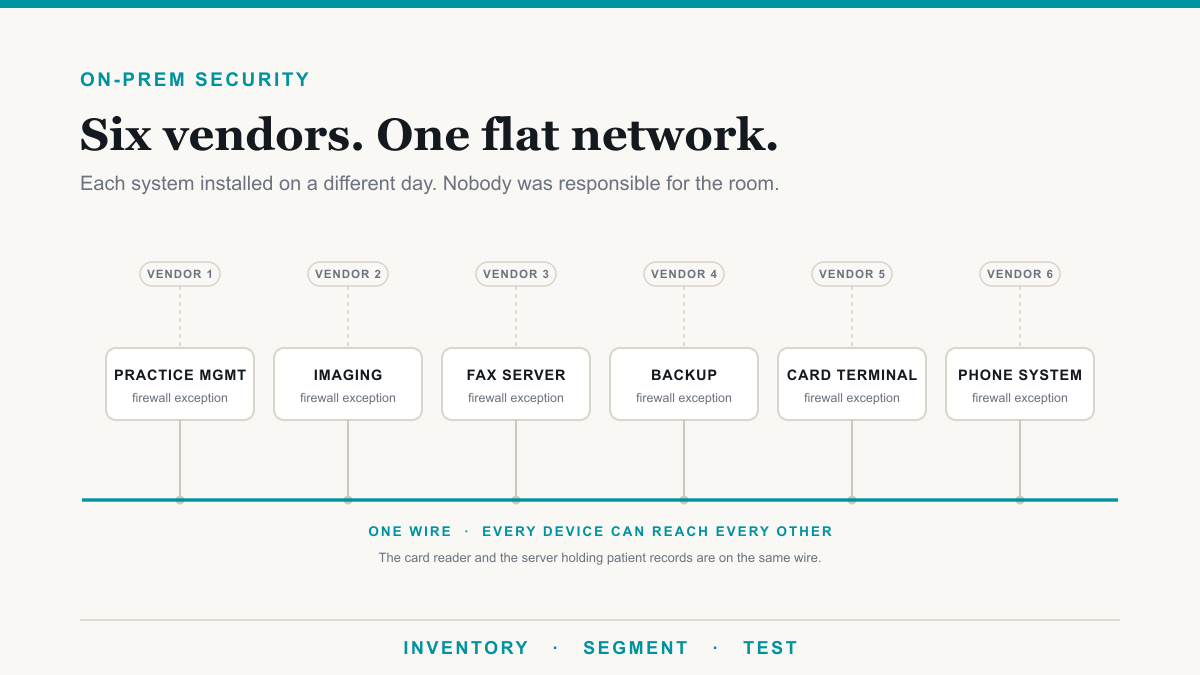
Dental offices sit in an awkward spot. You hold the same sensitive patient and payment data a hospital does, but you usually run on a fraction of the IT support. That combination is exactly what opportunistic attackers look for. It is not personal, it is just that a busy practice with valuable records and limited defenses is an easier target than a large hospital with a full security team. Closing that gap is the whole point of our dental managed IT services.
This is not hype. A 2025 review in the Journal of Dental Education looking at cybersecurity in dentistry lists ransomware, phishing, insider misuse, and poorly secured connected devices among the real threats dental organizations face, and it recommends regular security audits and outside cybersecurity help as part of the answer. A penetration test is one practical way to act on that advice rather than just worry about it.
The point of a pen test is not to scare you. It is to turn vague worry into a short, specific list of things you can actually fix.
How penetration testing supports HIPAA and cyber insurance
Here is an honest point that some vendors blur. The HIPAA Security Rule requires every practice to perform a risk analysis, which is a documented, honest evaluation of where patient data could be exposed. It does not specifically name penetration testing as mandatory. You can read the plain requirements on the HHS HIPAA Security Rule page. So no, a pen test is not strictly required by HIPAA.
What it is, though, is one of the strongest ways to meet that risk-analysis expectation, because it shows your real risks the way an attacker would see them, not just on paper. It gives you documented proof that you looked, found issues, and fixed them, which is exactly the kind of “reasonable safeguards” the rule is built around. If HIPAA compliance is something you want to feel solid about rather than hope about, testing is a concrete step.
Cyber insurance is the other driver. Carriers increasingly ask pointed questions about your security before they will cover you, and a clean, recent test helps you answer them honestly and keep your coverage in good standing. And if your practice takes card payments, the payment card security standards may also call for periodic testing, depending on how you process those payments. It is worth checking where you stand.
What a penetration test looks like for a dental office
A good test is scoped to your actual practice, not a generic checklist. For most dental offices it looks at the places that matter day to day:
- Your network and wifi. Could someone in the parking lot or waiting room reach your systems?
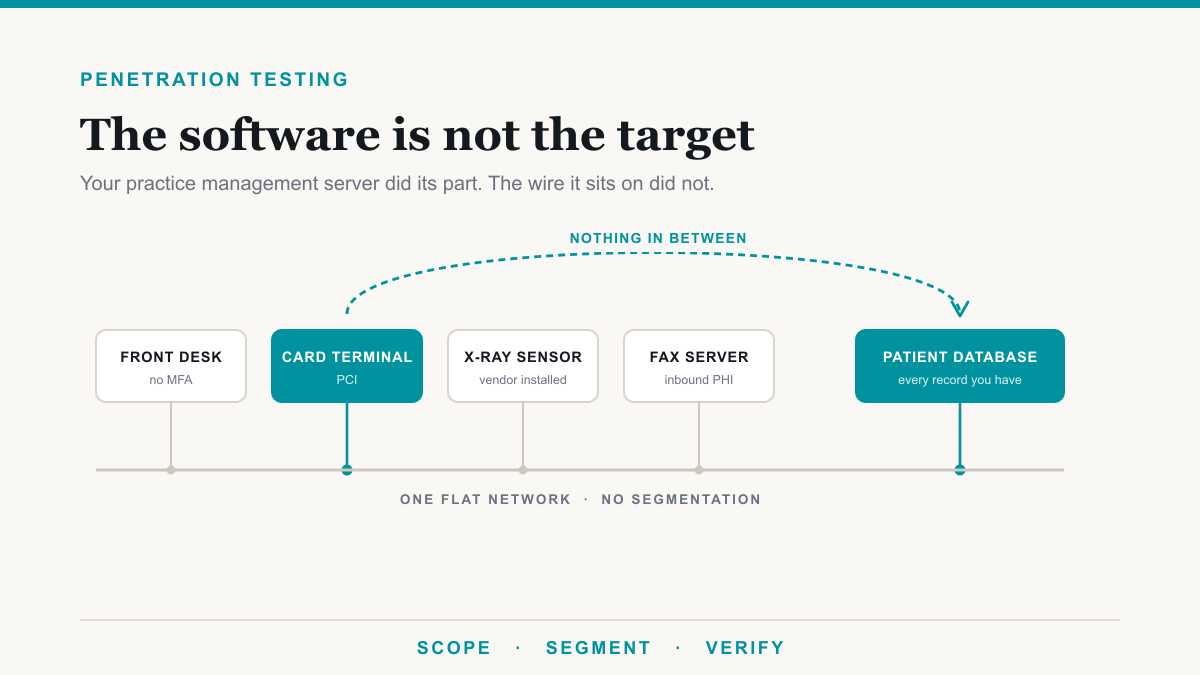
- Your patient records and practice software. If an attacker got a foothold, how far could they get toward the data? If your practice runs Open Dental, we cover exactly this in our guide to pen testing on Open Dental.
- Your staff. A safe, simulated phishing email shows how the team responds, since people are the most common way in.
- Anything facing the internet. Patient portals, remote access, and similar entry points get a hard look.
Testing usually blends two approaches. Automated tools cover a lot of ground quickly, and a human tester then digs into what the tools flag, trying to exploit and connect issues the way a real attacker would. The automated part keeps it affordable, and the human part is what catches the things that actually matter. You can see how Desert Lakes approaches both in our penetration testing service, and specialized engagements run through azpentest, our dedicated Arizona practice, including HIPAA penetration testing scoped for practices.
What you do with the results
A test is only useful if it leads somewhere. A good report should be readable, not a wall of technical output. It tells you what was found, ranks each issue by how serious it really is, and explains in plain terms what to do about it. From there the path is simple: fix the important things first, then confirm the fixes worked, ideally with a quick retest.
Most practices benefit from testing about once a year, and again after any big change, such as a new location, a major software switch, or a move to new patient portals. That cadence keeps your picture current without turning security into a constant project.
Frequently asked questions
Does my dental practice need a penetration test?
If your practice stores patient records, takes payments, or carries cyber insurance, a penetration test is worth strong consideration. It shows where a real attacker could get to your data and gives you documented proof you are taking patient privacy seriously, which supports both HIPAA and your insurance.
Is penetration testing required by HIPAA?
Not explicitly. HIPAA requires a documented risk analysis, but it does not name penetration testing as mandatory. A pen test is one of the strongest, most concrete ways to meet that risk-analysis expectation, because it reveals your real exposure rather than just a paper review.
How much does a penetration test cost for a dental practice?
It depends on the size of your network and how deep the test goes. For a single-location practice it is often more affordable than owners expect, and far less than the cost of a single breach. Ask for a scoped quote rather than assuming it is out of reach. If you are budgeting for the bigger picture, our guide to what dental IT support costs covers the monthly side.
How often should a dental practice have a penetration test?
About once a year is a sensible baseline for most practices, and again after major changes like a new location, a software switch, or new patient portals. Regular testing keeps your security picture current and your compliance and insurance answers honest.
The bottom line
Penetration testing for dental practices is not about fear, it is about confidence. When you know where your weak spots are and you have fixed them, you can tell a patient, an insurer, or an auditor that you take their data seriously and actually mean it. It turns a vague worry that sits in the back of your mind into a short, manageable list of things handled.
If you would like to know where your practice really stands, Desert Lakes Solutions offers a no-pressure discovery call to talk through your setup and what a right-sized test would look like for you. Book a discovery call and we will help you get a clear picture. And if your more immediate worry is what is sitting open inside Microsoft 365, The Copilot Exposure List pulls the actual patient-record files anyone on your team can open today, at no charge for qualified practices.