Fortinet Firewalls for Small Business: Cost, Models, and Protection
Published June 3, 2026, updated August 29, 2026

A Fortinet firewall for an office costs in three layers: the appliance itself, the annual security subscription that keeps its protection current, and setup or ongoing management, so the real lifetime cost runs well above the sticker on the box. In mid-2026 street pricing, an entry desktop unit like the FortiGate 30G runs about $450 for the hardware, the 40F and 60F class typically lands between $1,100 and $2,100 bundled with a first year of security licenses, and the management layer is either your staff’s time or a provider; for our clients it is included in the monthly plan, and the full install with switch and Wi-Fi starts at $9,500. For an owner trying to budget, that gap between the sticker and the real total is exactly what matters. If you have been pricing out a Fortinet firewall for your office and want to know what it actually costs over the life of the device, this guide lays it out in plain terms, then covers which FortiGate model fits, what the firewall actually protects against, and how to keep the cost sensible. It is written for owners and office managers of small practices, firms, and shops: the kind of place that needs solid protection without an enterprise budget.
The short version is that the cost of a Fortinet firewall comes in three layers, and only one of them is the price you see first. Understanding all three up front is the difference between a clean budget and an unwelcome renewal notice a year later.
What we actually install, and what it costs. A small-office network from Desert Lakes Solutions is a FortiGate 40F with a three-year security bundle, a managed switch, one Wi-Fi access point, and the setup, from $9,500 installed. A new-suite build-out with more access points runs closer to $12,000. After that the firewall is managed inside your monthly plan, no separate per-appliance fee. Get a FortiGate quote.
What you are actually paying for
When people ask what a Fortinet firewall costs, they are usually picturing a single number for the box. In reality, the total breaks into three parts, and a sensible budget accounts for all of them.
- The hardware (FortiGate appliance). This is the physical device that sits at the edge of your network. Fortinet’s small-office models, the desktop FortiGate units, are sized for a handful to a few dozen users, and this is a one-time purchase. As of mid-2026, the entry FortiGate 30G streets around $450 on its own, and the 40F and 60F class commonly lands between $1,100 and $2,100 when bundled with first-year security licenses.
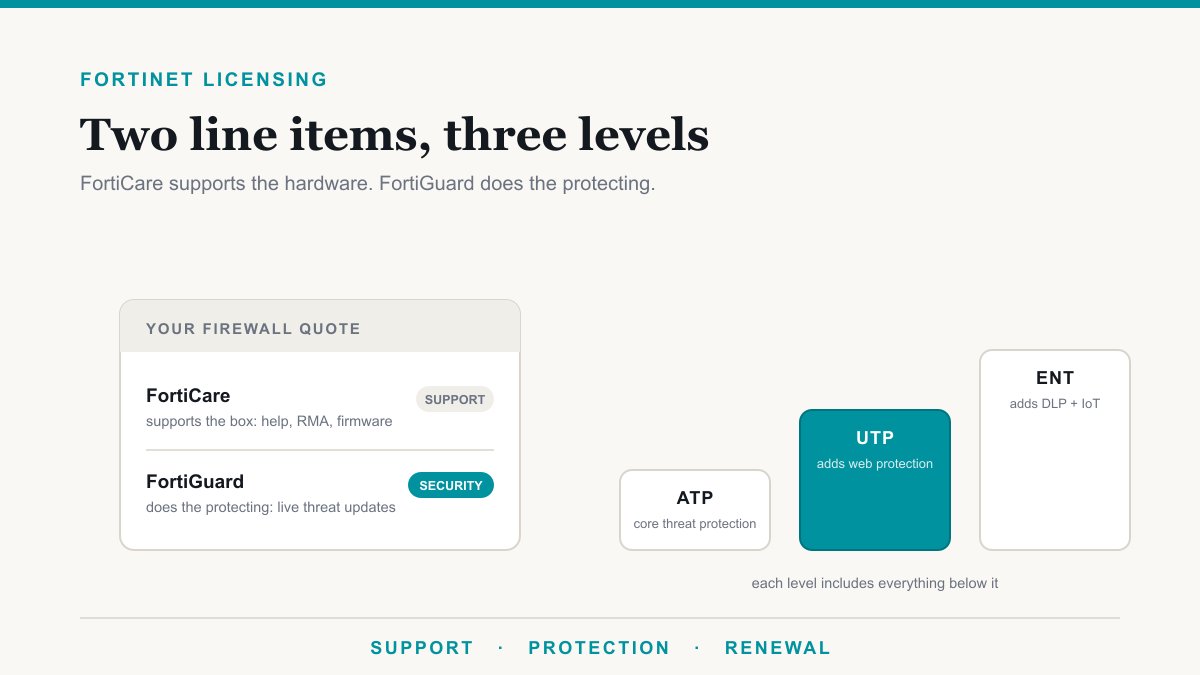
- The security subscription (FortiGuard). This is the part most people miss. The hardware on its own is a capable router and basic firewall, but the features that actually block modern threats, things like intrusion prevention, web filtering, and antivirus inspection, come through Fortinet’s FortiGuard security subscriptions. These are billed per year, per device. For the entry desktop models, plan on a few hundred dollars to roughly a thousand a year depending on the bundle and term you choose.
- Setup and ongoing management. Someone has to configure the device correctly, keep its firmware current, and respond when it flags something. You can do this in-house, or have a provider manage it. Either way it is a real cost, in dollars or in your team’s time. Ours is simple: firewall management is included in every managed IT plan, and the install is a one-time project from $9,500.
A firewall that is bought but never tuned or updated is a common and expensive mistake. The appliance is only as good as its configuration and its current threat intelligence, which is exactly why the subscription and the management are not optional extras. They are what make the hardware worth owning.
Why the annual subscription catches budgets off guard
This is where budgets go wrong most often. A business buys the FortiGate hardware, pays for the first year of security services bundled in, and feels covered. Then a year later the renewal arrives, and it was not in the plan. The hardware keeps working, but the protective services it relies on lapse, which quietly leaves the business more exposed than the owner realizes.
The honest way to think about a Fortinet firewall cost is as a hardware purchase plus a recurring annual line item, much like insurance. The recurring piece is the part doing the active protecting: Fortinet’s threat-intelligence service updates the device continuously as new attacks appear. Budgeting for that renewal from day one keeps it from ever landing as a surprise. If you want to know exactly what the support contract and each subscription level include, our guide to Fortinet firewall licensing (FortiCare vs FortiGuard) breaks the line items down.
What drives the price up or down
There is no single price because a few factors move it, and most of them are within your control. The point here is to understand the levers, since quoting a single figure would be out of date by next quarter.
Because those factors combine differently for every business, Fortinet pricing varies more than most people expect, and that is the honest answer to why you will not find a single sticker price online. The FortiGate line runs from small desktop units for tiny offices up through larger appliances, with the annual security subscription layered on top, and the only reliable way to land on a real number is to have it quoted for your specific setup.
| Cost factor | What it means for your budget |
|---|---|
| Appliance size / model | Bigger models handle more users and faster internet. A small office often needs an entry-level desktop FortiGate; paying for a larger model you will not grow into is wasted budget. |
| Subscription bundle | Fortinet offers tiers of security services. A fuller bundle costs more per year but covers more threat types. Match the bundle to your actual risk. A longer feature list does not automatically mean a better fit. |
| Term length | Subscriptions are commonly sold in one, three, or five year terms. Longer terms usually lower the cost per year and lock in the price. |
| Managed vs. self-managed | Managing it yourself saves a monthly fee but costs staff time and assumes the know-how. A managed firewall folds setup, updates, and monitoring into one predictable cost. |
Should you manage a FortiGate yourself or pay for managed?
If someone on your staff genuinely knows FortiOS and has the hours to watch it, self-managing is the cheaper path on paper: no monthly fee, just their time for firmware updates, rule changes, and reading the alerts, which realistically runs a few hours a month done properly. For everyone else, managed wins the honest math. A managed FortiGate at our shop is folded into the monthly IT plan as one predictable cost, and it buys the initial configuration done right, firmware kept current, someone actually watching the alerts, and a person to call when traffic stops. Weigh that against the cost of one bad afternoon of downtime or one missed intrusion alert.
The real question is who will still be maintaining the firewall in month eighteen. Setting it up on day one is the easy part. The pattern we see most often is a FortiGate that was configured well on day one and never touched again: firmware two years old, rules nobody remembers, alerts going to an inbox nobody reads. At that point the business is paying Fortinet prices for router-grade protection. If that sounds like where you would land, managed is the safer budget line: the firewall stays configured, current, and watched as part of the monthly plan.
Which FortiGate model is right for your office
The right FortiGate is the one sized to how you actually work. That usually rules out both the biggest model on the shelf and the cheapest box that would leave you exposed. Three things decide it: how many people sit behind the firewall, how fast your internet connection is, and which security features you need switched on. A small office of a handful to a few dozen users on a typical business internet plan almost always fits one of Fortinet’s entry-level desktop FortiGate units, which still give you the protective features that matter: intrusion prevention, web filtering, a secure VPN for remote staff, and malware inspection. In current models that means the FortiGate 30G, around $450 street for the hardware, for a micro office of up to roughly ten people, and the 40F or 60F class, typically $1,100 to $2,100 bundled with first-year licenses, once you have a few dozen users, a faster connection, or heavier inspection turned on. A mid-range model earns its price only once you have more users, faster throughput, or heavier security requirements than those units can comfortably carry.
The common mistake runs in both directions. Buy too small and the firewall becomes a bottleneck the day your team grows or your internet gets faster. Buy too big and you have paid for capacity you will not touch for years. The honest way to land it is to size to your real user count and connection speed with a little headroom, then focus on the security bundle you choose: that is what actually does the heavy lifting, far more than the model number. If you are not sure where you fall, that sizing is exactly the kind of thing we work out on a short call before anyone buys anything. A dental office is a common fit for those entry-level units; we cover the practice floor plan, guest Wi-Fi split, and HIPAA logging in firewall for dental practices.
Why there is no fixed Fortinet price list
This is the part that surprises a lot of first-time buyers, so it is worth saying plainly. Fortinet gear is not sold like a retail product with a fixed shelf price. It moves through authorized channel partners and distribution, and the final number is built for each business based on the model, the subscription bundle, the term you choose, and whatever pricing and promotions are current at the time. Two businesses can pay different amounts for what looks like the same box, and the same box can be priced differently from one quarter to the next.
In practice that means the dependable way to get a real figure is a quote configured for your setup. A number pulled off a website will not reflect your actual bundle, term, or promotions. As a channel partner, this is something we handle for our clients: we size the right model, choose the bundle and term that fit the budget, pull the quote, and come back with one clear figure. It also means we can steer you away from paying for capacity or a tier you do not need, which is usually where the surprises hide.
How Fortinet compares on value
If you are shopping for a firewall for your office, you will almost certainly be comparing Fortinet against Cisco Meraki, and it is a fair comparison: both are well-built, widely trusted platforms. The difference tends to show up in what you get for the money. In our experience pricing the two side by side, Fortinet often delivers more security capability at a given price point, which is a big part of why it keeps winning on value for cost-conscious businesses.
The tradeoff is configuration depth. Meraki’s reputation is built on simplicity: it is cloud-managed and famously quick to stand up, which suits businesses that want minimal fuss. Fortinet gives you more knobs to turn, which can mean tighter, more granular security, but it also means setup and tuning take more know-how to get right. The extra capability only pays off if the device is configured well, which is exactly where having a partner who knows the platform earns its keep. Handled right, you get Meraki-grade ease of ownership with Fortinet’s value and depth underneath. If you want a closer look at the other side, our guide to Cisco Meraki pricing for your office covers where it shines.
What a Fortinet firewall actually protects against
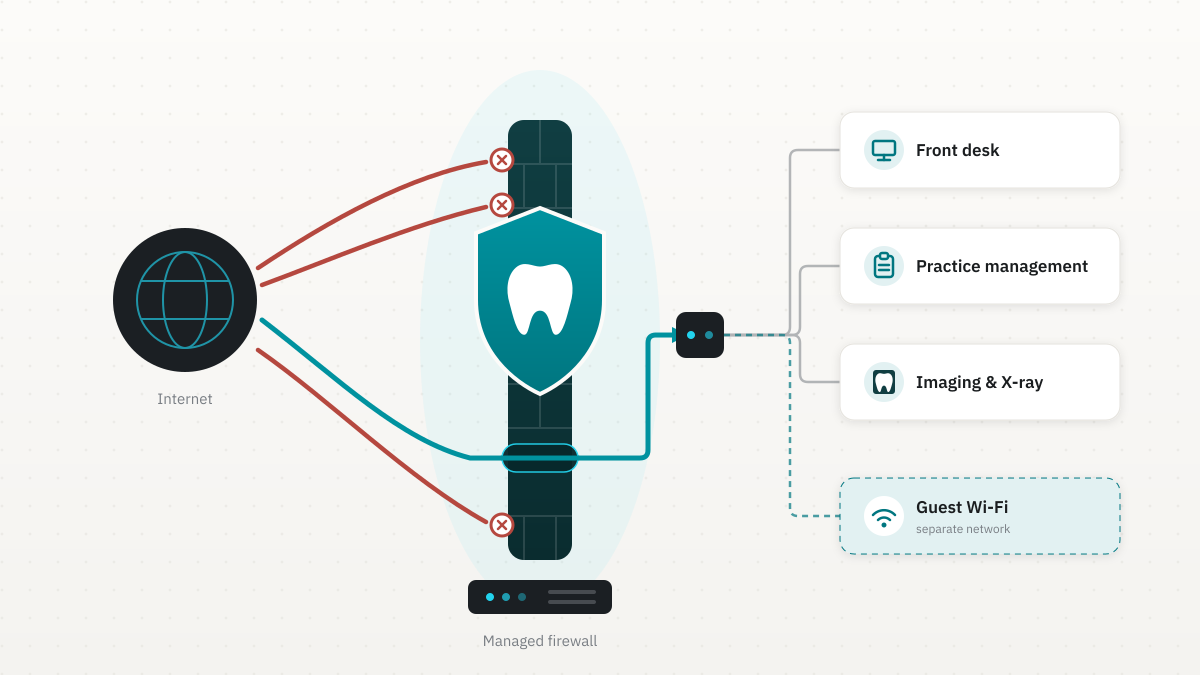
It helps to know what you are buying on the security side, because that is where the recurring subscription earns its place in the budget. A FortiGate sits at the edge of your network and inspects the traffic moving in and out, then blocks the bad before it reaches your workstations, servers, and point-of-sale, using deep packet inspection to look at what is actually inside the traffic. That is how it catches threats that a basic router waves straight through.
In practice that means intrusion prevention that stops known attack patterns at the door, web and content filtering that keeps staff off malicious sites, and antivirus and malware inspection aimed at ransomware, zero-day attacks, and the phishing payloads that make up most of what actually hits an office. Those are the features the FortiGuard subscription keeps current. Switch the subscription off and the box still routes traffic, but it stops recognizing anything new, which is the quiet gap that gets businesses hurt.
How Fortinet keeps up with new threats
A firewall is only as good as how current it is, because the threats it faces change every week. This is what the annual subscription is really buying. Fortinet runs a global threat-research team, FortiGuard Labs, that tracks new attacks as they appear and pushes updated protection out to every FortiGate on subscription, so your firewall recognizes this month’s ransomware and phishing tactics without you lifting a finger. Newer detection leans on AI and machine learning to flag patterns that do not match anything seen before, and Fortinet’s Security Fabric lets the firewall, endpoint protection, and the rest of the stack share signals and defend as one connected unit.
For an office the takeaway is simple: this protection works as an ongoing service, kept current for as long as the subscription runs. That is the reason the yearly renewal matters, and it is why an unmaintained firewall quietly falls behind the very threats it was bought to stop.
How to budget without overbuying
The goal is protection sized to what you actually need, and the biggest box on the shelf is rarely it. A few practical moves keep the cost sensible:
- Size to your real user count and internet speed, with a little headroom for growth. Skip the model marketed at companies ten times your size. The section above on choosing a FortiGate model walks through how to match it.
- Plan for the renewal now. Put the annual subscription in the budget the day you buy the hardware so it is never a surprise.
- Ask about a multi-year term when you request a quote, since it typically lowers the yearly cost and protects you from price changes.
- Weigh managed against self-managed honestly. If no one on staff is going to keep the firmware current and watch the alerts, a managed option is often cheaper than the breach or downtime that an unmaintained firewall invites.
For many businesses, the steadiest approach is to roll the hardware, the subscription, and the management into one predictable monthly cost through a managed services arrangement. That turns a lumpy purchase with a yearly surprise into a single, plannable line item, and it means someone is actually watching, patching, and keeping the firewall current so it does not quietly go out of date sitting in a closet. Desert Lakes Solutions works with businesses across the Phoenix metro, including Mesa, Gilbert, and Chandler, on exactly this kind of setup.
Is a Fortinet firewall worth the cost for your office?
For most offices that handle sensitive data, take payments, or simply cannot afford to be offline, yes. A properly configured and maintained firewall is one of the more cost-effective pieces of protection you can put in place, because it works quietly in the background against a wide range of threats. The federal government’s cybersecurity guidance for smaller organizations consistently lists a properly managed firewall among the basics. The cost is real, but so is the cost of the downtime, lost data, or compliance trouble it helps you avoid.
Frequently asked questions
How much does a Fortinet firewall cost?
Plan for three layers. The hardware: an entry FortiGate 30G streets around $450, and the 40F and 60F class typically runs $1,100 to $2,100 bundled with first-year security licenses. The annual FortiGuard renewal after year one: a few hundred dollars to roughly a thousand for entry models, depending on bundle and term. And setup or management: staff time, or a provider. At Desert Lakes Solutions firewall management is included in every managed plan, and a full small-office install (FortiGate 40F, switch, access point, setup) starts at $9,500. Budgeting for all three avoids surprises.
What does a managed FortiGate firewall cost per month?
At Desert Lakes Solutions there is no separate managed firewall fee: configuration, firmware updates, monitoring, and response are included in every managed IT plan. The one-time install of a FortiGate 40F with a switch and access point starts at $9,500. Self-managing avoids the plan but costs real staff hours, and it assumes someone is actually watching the device eighteen months in, well past the first day.
Why can’t I find Fortinet firewall prices online?
Fortinet sells through authorized channel partners, so there is no fixed retail price: each quote is configured for the specific model, bundle, term, and current promotions. That is why prices vary between businesses and over time. A quote built for your setup is the reliable way to get a real number.
Do I have to pay for Fortinet every year?
The hardware is a one-time purchase, but the FortiGuard security services that block modern threats are sold as an annual subscription per device. The firewall keeps running if the subscription lapses, but its active protection stops updating, so the yearly renewal is worth planning for.
Which FortiGate model is right for your office?
Most small offices fit an entry-level desktop FortiGate, sized to your user count and internet speed with a little room to grow. A mid-range model earns its price once you have more users, faster throughput, or heavier security needs. Buying larger than you need is wasted budget.
Is Fortinet better value than Cisco Meraki?
For most offices, yes on value. Fortinet often delivers more security capability for the price, while Meraki is prized for its simplicity and quick setup. Fortinet’s tradeoff is more configuration depth, which rewards good setup, so the gap narrows when the device is professionally configured.
How does a Fortinet firewall protect an office?
It sits at the edge of your network and inspects the traffic moving in and out, using deep packet inspection to look at what is actually inside the traffic, beyond just where it is headed. That lets it block intrusions, malicious sites, ransomware, and malware before they reach your workstations and servers. The FortiGuard subscription is what keeps that protection current.
Does a Fortinet firewall keep up with new threats?
Yes, as long as the subscription is active. Fortinet’s FortiGuard Labs threat-research team tracks new attacks and pushes updated protection to every FortiGate on subscription, so your firewall recognizes current ransomware and phishing tactics automatically. That ongoing update is the real thing the annual renewal buys.
Can a business with no IT staff run a Fortinet firewall?
It can, but the honest answer is that a FortiGate rewards good setup and upkeep, and an unconfigured or unmaintained firewall leaves gaps. For a business without in-house IT, a managed firewall, where a provider handles the setup, updates, and monitoring for one predictable cost, is usually the safer and cheaper path than leaving it to chance.
Is a FortiGate worth the price?
For most offices that handle sensitive data, take payments, or cannot afford downtime, yes. An entry FortiGate with first-year licenses typically runs about $450 to $2,100, plus a yearly subscription that keeps protection current. The box is worth it when it is configured and maintained. An unmaintained FortiGate is just an expensive router.
Budgeting for the right protection
The real Fortinet firewall cost is the hardware plus the annual security subscription plus keeping it managed, and the businesses that budget for all three get protection that actually holds up. Right-size the model, plan for the renewal, and get a quote built for your setup. Guessing from a number online will not reflect your real bundle or term.
If you would like a real figure for your business, Desert Lakes Solutions offers a no-pressure discovery call to walk through your current setup, the right-sized option, and a clear monthly number with no surprises. Book a discovery call.