Fortinet Firewall Licensing Explained: FortiCare vs FortiGuard
Published July 20, 2026
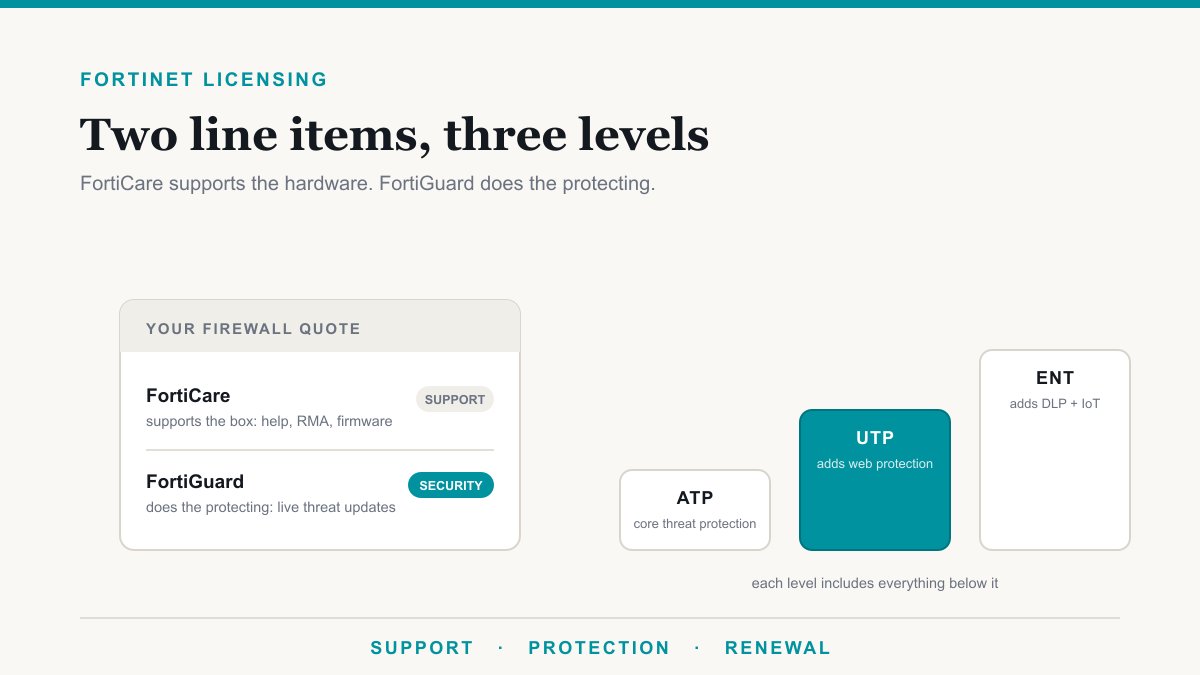
Fortinet firewall licensing has two separate layers: FortiCare, the support contract that covers the hardware itself, and FortiGuard, the security subscription that does the actual protecting, sold in three bundle levels called ATP, UTP, and Enterprise Protection. Knowing which layer does what is the difference between a renewal you planned for and a firewall that quietly stopped protecting you a year after it was installed. This guide is for owners and office managers who have a FortiGate quote or renewal notice in hand and want to know, in plain terms, what each line item buys and which level actually fits a small office.
Fortinet firewall licensing is two things, not one
Every complete FortiGate quote has two kinds of line item on it, and they answer two different questions.
- FortiCare answers "who helps me with the box?" It is the support contract: access to Fortinet's technical support team, hardware replacement if the unit fails, and access to firmware updates that keep the device itself current. Without it, you own an appliance nobody stands behind.
- FortiGuard answers "what keeps the protection current?" It is the security subscription. Fortinet's threat-research team pushes a continuous stream of updated intelligence to every subscribed FortiGate: new malware signatures, new intrusion patterns, and live ratings for the websites your staff visit. The hardware provides the muscle; FortiGuard provides the judgment.
The reason this distinction matters to your budget is that both renew, and a lapse in either one costs you something real. A lapsed FortiCare contract means no support call and no firmware updates when you need them. A lapsed FortiGuard subscription means the protective features stop being current, which is a quieter and more dangerous failure. We covered the budgeting side of this in our guide to what a Fortinet firewall costs a small office; this post is about what the levels themselves contain.
The FortiGuard bundle levels: ATP, UTP, and Enterprise Protection
Fortinet sells the security services a la carte, but most growing companies buy them as one of three bundles. Each level includes everything in the level below it, per Fortinet's bundle descriptions.
| Bundle | What it adds | Who it usually fits |
|---|---|---|
| ATP (Advanced Threat Protection) | The core protections: intrusion prevention, antivirus and advanced malware protection, a cloud sandbox that safely detonates suspicious files, and application control. | Offices whose web browsing is already filtered by a separate tool. |
| UTP (Unified Threat Protection) | Everything in ATP, plus web protection: URL and DNS filtering, video filtering, and blocking of botnet and command-and-control traffic. | Most small offices. Web filtering is the piece almost always needed. |
| ENT (Enterprise Protection) | Everything in UTP, plus data loss prevention, attack surface monitoring and risk scoring, AI-based inline malware prevention, and IoT device detection. | Larger or heavily regulated environments with more to watch. |
In plain terms: ATP watches the traffic for attacks, UTP also manages where your people can go on the web, and Enterprise Protection adds visibility into data leaving the business and the odd devices connected to your network. For the small practices, firms, and shops we work with, UTP is the level we quote most often, because category-based web filtering is the feature owners actually feel day to day: it is what keeps a busy front desk off a phishing page.
FortiCare support levels: Essential, Premium, and Elite
Support has its own three levels, described in Fortinet's FortiCare ordering guide.
- Essential is the base tier: web tickets with next-business-day response, and it is only offered on the very smallest FortiGate models. It exists for devices with low stakes.
- Premium is the standard business tier: support around the clock, with a one-hour response target for critical issues, plus hardware replacement shipping the next business day.
- Elite raises the response target to fifteen minutes and adds an enhanced support portal. It is aimed at environments where a firewall outage is measured in minutes, not hours.
Here is the part that simplifies most quotes for a small office: the FortiGuard bundles include FortiCare Premium. Buy ATP, UTP, or Enterprise Protection and the 24x7 support contract is already in the price. That is why a typical small-office FortiGate quote comes as one simple bundle line per device, which makes it easier to compare.
What happens when the licenses expire
This is the part of Fortinet licensing that catches people off guard, so it is worth understanding well before renewal time. When the subscriptions lapse, the FortiGate does not shut down. It keeps routing traffic and enforcing your firewall rules, which is exactly why nobody notices the problem.
What actually happens, confirmed in Fortinet's own community forum, is quieter. Antivirus and intrusion prevention keep running on the last signatures they downloaded, so protection against new threats degrades a little more each week. Category-based web filtering stops working outright, because those ratings are live lookups to FortiGuard, and depending on how the policy is configured an expired web filter can even start blocking sites broadly until someone intervenes. Access to Fortinet's support team and to firmware updates ends with the FortiCare contract. The box works; the protection ages.
An expired firewall looks fine on the shelf and fails the two moments that matter: the day a new strain of ransomware arrives, and the day an insurer or auditor asks whether your edge protection is actively maintained. If you keep one date on a compliance calendar for your network, make it this renewal.
Which licensing level a small office actually needs
Our honest default for a small office is UTP on an appropriately sized desktop FortiGate. It covers the threats that most offices actually face, includes the web filtering an office almost always wants, and carries FortiCare Premium with it. ATP can make sense where a separate web-security product already covers browsing, and Enterprise Protection earns its price in bigger or heavily regulated environments, but neither is the common case at that size.
The bigger point is that the license is only half the job. Somebody has to size the model, configure the features the subscription unlocks, keep the firmware current, and renew the licensing before it lapses. That is why we fold FortiGate licensing into managed IT and our security service rather than treating it as a box sale: the renewal becomes our calendar item instead of your surprise, and the features you are paying for are actually turned on and tuned. A surprising share of the firewalls we inherit from other setups have an active UTP license and web filtering half-configured, which is paying for protection and not receiving it.
Frequently asked questions
What is the difference between FortiCare and FortiGuard?
FortiCare is the support contract for the device: technical support, hardware replacement, and access to firmware updates. FortiGuard is the security subscription that keeps the firewall's protections current with live threat intelligence. FortiCare supports the box; FortiGuard does the protecting. A complete quote includes both.
What is the difference between the ATP and UTP bundles?
ATP covers core threat protection: intrusion prevention, antivirus and malware protection, a cloud sandbox, and application control. UTP includes everything in ATP and adds web protection: URL and DNS filtering, video filtering, and blocking of botnet communication. For offices where staff browse the web, UTP is usually the better fit.
What happens when a FortiGate license expires?
The firewall keeps passing traffic, but its protections stop updating. Antivirus and intrusion prevention keep using the last signatures they downloaded, web filtering by category stops working because those lookups are live, and access to Fortinet support and firmware updates ends. The box works; the protection ages.
Does a FortiGate work without any subscription?
Yes, as a router and basic firewall. Traffic still flows and your firewall rules still apply. What you lose is everything subscription-driven: current threat signatures, web filtering, sandboxing, and vendor support. For a business device guarding patient or client data, running unlicensed defeats the reason you bought it.
Which FortiGuard bundle does a small office need?
For most small offices, UTP is the sensible default because it includes web filtering, which ATP does not. ATP can fit where a separate web-security tool already covers browsing. Enterprise Protection adds data loss prevention and IoT visibility that larger or heavily regulated environments are more likely to use.
Do I need to buy FortiCare separately if I buy a bundle?
Usually not. The FortiGuard bundles include FortiCare Premium support, so a bundle quote already covers 24x7 technical support and hardware replacement alongside the security services. Buying support separately mainly comes up with a la carte licensing, or when a device only needs support and no security services.
How do I check when my Fortinet licenses expire?
The FortiGate's own dashboard shows the status of each license, and the Fortinet support portal lists expiration dates for every registered device. If a provider manages your firewall, ask them to confirm the renewal date and who owns the renewal. Lapsed by accident is the most common licensing failure we see.
Making Fortinet firewall licensing someone's job
Fortinet firewall licensing comes down to two layers and three levels: FortiCare supports the hardware, FortiGuard keeps the protection current, and the ATP, UTP, and Enterprise bundles decide how much protecting the device does. Pick the level that matches your business, then make sure the renewal and the configuration belong to someone specific, because an expired or half-configured firewall protects nobody. If you would like a second set of eyes on a FortiGate quote or renewal notice, or you are not sure what level your current firewall is even licensed at, Desert Lakes Solutions offers a no-pressure discovery call to walk through it with you. Book a discovery call and bring the quote.