Fortinet vs Cisco Meraki for Small Business: Cost, Control, and Which to Buy
Published September 17, 2026

Fortinet is the cheaper and more capable choice for most businesses, and Meraki is the easier one to look at day to day; the same small office runs about $9,500 installed on Fortinet and roughly $10,000 in hardware and licenses on Meraki before anyone touches a cable. That gap matters because a firewall is a ten-year budget decision with a renewal in the middle of it, not a one-time box. This guide is for owners and office managers comparing Fortinet vs Meraki for a practice, firm, or shop, and it lays out the real prices, what each platform is like to live with, and where each one fits. We install and support both.
Fortinet vs Meraki: the short version
The two platforms sell to the same buyer with opposite promises. Cisco Meraki promises that you will never need to understand your network: every device reports to one cloud dashboard, and the dashboard does the thinking. Fortinet promises more security per dollar and full control, with the understanding that someone competent sets it up and keeps an eye on it.
Both promises are true. The catch with Meraki is that set-and-forget almost never holds long term. Offices grow, a vendor needs a port opened, an insurer wants a specific rule proven, a phone system needs priority. At that point you are doing networking either way, and on Meraki you are doing it with fewer tools while paying more for the privilege. That is the whole comparison in one paragraph. The rest of this post is the evidence.
What the same small office costs on each
Here is a typical small office: one firewall, one 48-port PoE switch, one Wi-Fi access point, installed and configured, with three years of the security licensing that both vendors require for real protection. Prices are 2026 street figures from our own quotes.
| Item | Fortinet | Cisco Meraki |
|---|---|---|
| Firewall with three-year security bundle | FortiGate 40F, about $1,456 | From about $2,500 (an MX75 is $2,900 for the hardware alone) |
| 48-port PoE switch | Managed switch, included in the package below | Meraki-managed Catalyst C9200L-48P: $3,600 hardware only, $7,483 with the three-year license |
| Install labor | Same | Same |
| Whole package, installed | From $9,500 | Roughly $10,000 in hardware and licenses before labor |
The switch line is the one to stare at. The Meraki hardware is not wildly expensive on its own. The license is what does it: on that switch the three-year license more than doubles the price of the box. Every Meraki device carries its own license, so the gap widens with every access point and switch you add. Fortinet's licensing sits on the firewall; a FortiSwitch or a third-party switch behind it does not need a security subscription to keep working.
On the Fortinet side, a new-suite build-out with more access points runs closer to $12,000 installed. That is the number to use if you are opening a location rather than replacing gear in one. Our Fortinet firewall cost guide breaks down the model choices, and the Meraki cost guide does the same for the MX line.
The license question is different on each platform
Both vendors sell an annual security subscription, and both firewalls are much less useful without it. What happens when it lapses is not the same.
- Meraki: the license is required to operate. Cisco's own licensing FAQ describes a 30-day grace period after expiration, after which the network stops passing traffic until a license is applied. A missed renewal is an outage.
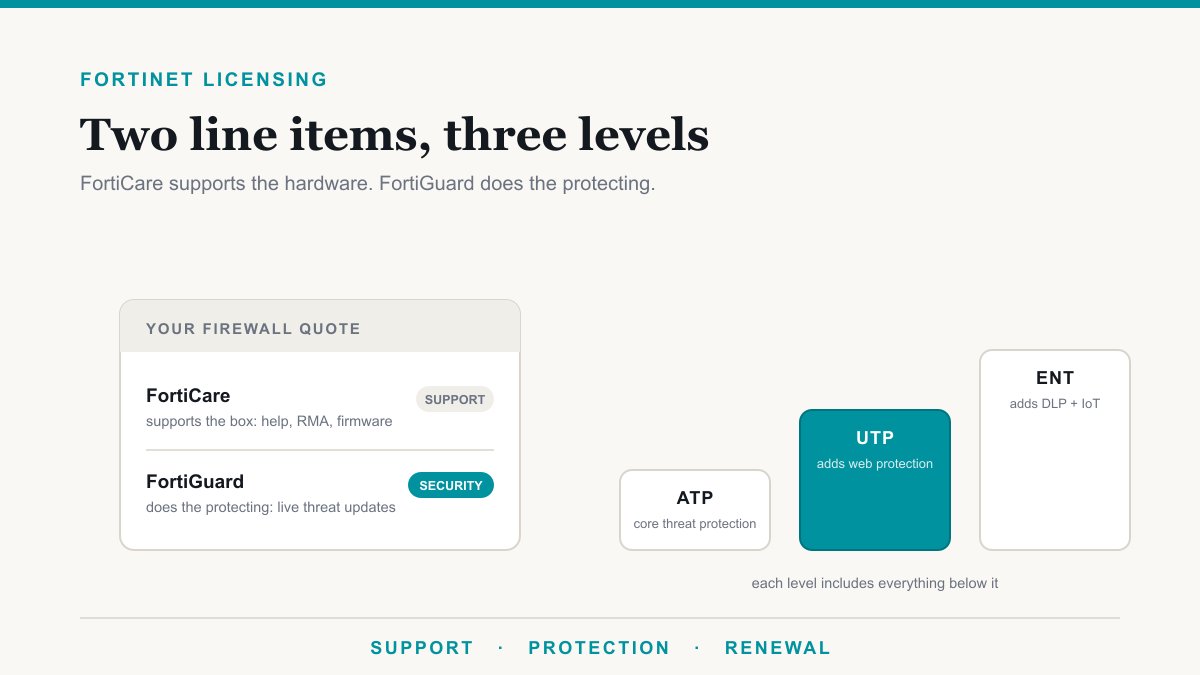
- Fortinet: the hardware keeps routing when the FortiGuard subscription lapses. Intrusion signatures, web filtering, and antivirus stop updating, so protection degrades, but the office stays online. Our Fortinet licensing explainer covers the FortiCare and FortiGuard layers.
Neither behavior is wrong. Meraki's is the price of the cloud model: the dashboard is the product, and the dashboard is what you are licensing. It just means a Meraki renewal calendar is a business-continuity item, not an accounting one.
What each one is like to manage
This is where Meraki earns its price, and where the limits show up.
Where Meraki is genuinely better
- One dashboard for everything. Firewall, switches, access points, and cameras in one browser tab, with sane defaults. An office manager can see that the network is up without calling anyone.
- Easier ongoing changes. Adding an access point or a VLAN is a few clicks, and the same change rolls out to every site if you have more than one.
- Responsive vendor support. Cisco's Meraki support is arguably better than Fortinet's for a small customer. When a unit is misbehaving and they cannot resolve it, they will overnight a replacement, which is a real advantage when you are down.
Where Fortinet is genuinely better
- A command line and real logs. A FortiGate can capture packets, show you every session, and tell you exactly why something was blocked. Meraki has no command line and thin logs, so a hard problem often gets solved by replacing the box rather than understanding it. Replacement fixes hardware faults. It does not fix a configuration or a misbehaving upstream carrier.
- More security for the money. The FortiGuard bundle on an entry FortiGate includes intrusion prevention, web filtering, application control, and SSL inspection at a price Meraki does not match, which is why Fortinet keeps winning our side-by-side quotes. The FortiGate line also scales from a desktop unit to a data-center appliance on the same software.
- Control. Every setting is reachable. That is also the honest downside: Fortinet rewards good setup and punishes sloppy setup, so it is a worse choice for an office with nobody watching it. That is what a managed IT plan is for; firewall management is included in ours at no separate charge.
So which should you buy?
Buy Fortinet if the budget matters, if you want to know what your firewall is doing, and if you have or hire someone who knows networking. It is the better product and the cheaper one, and that combination is unusual.
Buy Meraki if you value the dashboard-only experience enough to pay meaningfully more for it, you have several sites that should look identical, and you are comfortable that troubleshooting will mostly mean calling Cisco. Plenty of businesses make that trade with their eyes open.
What we would steer you away from is buying Meraki because you plan never to think about the network. In our experience that plan lasts until the first vendor integration or insurance questionnaire. If you are in a regulated field, our security services page covers how the firewall fits into the rest of the controls an insurer or auditor will ask about.
Frequently asked questions
Is Fortinet or Meraki cheaper?
Fortinet, by a wide margin once licensing is counted. A FortiGate 40F with a three-year security bundle is about $1,456. A Meraki firewall with a three-year license starts around $2,500, and a Meraki-managed 48-port PoE switch with its three-year license is $7,483. The install labor is the same either way.
Is Meraki easier to manage than Fortinet?
Day to day, yes. Everything on Meraki lives in one cloud dashboard, and it is built for people who do not want to think about networking. Fortinet has a full command line and much deeper logs, which makes it harder to learn and much easier to troubleshoot when something actually goes wrong.
What happens if a Meraki license expires?
The hardware stops working. Meraki gives a 30-day grace period after expiration, and then the devices stop passing traffic until a license is applied. A FortiGate keeps routing when its FortiGuard subscription lapses; only the security updates stop, so the firewall degrades rather than going dark.
Which is better for troubleshooting, Fortinet or Meraki?
Fortinet. It has a command line, packet capture, and detailed logs on the box. Meraki has no command line and thin logs, so a hard problem often ends with Cisco support overnighting a replacement unit rather than anyone finding the root cause. Cisco is responsive about that, which is a real plus, but it is not the same as fixing it.
Which should you choose, Fortinet or Meraki?
If the budget matters and you have, or hire, someone who knows networking, Fortinet gives you more protection, more control, and a lower total cost. Meraki fits a business that wants a dashboard-only experience and is willing to pay meaningfully more for it. Most small offices we price for land on Fortinet.
Fortinet vs Meraki: deciding with the numbers in front of you
The Fortinet vs Meraki decision comes down to whether you are paying for ease or for capability, and the prices above show how much ease costs. Both platforms are well built and we support both. If you would like the two quoted side by side for your office, Desert Lakes Solutions offers a no-pressure discovery call to walk through your current setup, the right-sized option on each platform, and one clear installed number for each. Book a discovery call.