MDR vs SOC: What's the Difference and Which Do You Need?
Published February 9, 2024, updated August 4, 2026

A Security Operations Center (SOC) is a team of security analysts who watch your systems for signs of attack around the clock, and Managed Detection and Response (MDR) is a subscription service that gives you that team without hiring it. So the comparison is not product versus product, it is build versus buy, and for a small or mid-sized business the practical answer is almost always buy. This post is for practice owners and office administrators who keep seeing both acronyms in security quotes and insurance applications and want to know what they are actually being sold.
The short version
- A SOC is the team: analysts, tooling, and a process for acting on what they find.
- MDR is that team by subscription, run out of the vendor's own SOC.
- Unless you are large enough to staff security analysts in shifts, you buy, and the useful questions are about scope and response, not the acronyms.
What a SOC is once you strip the acronym
A Security Operations Center is three things bundled together:
- People. Security analysts working in shifts, so that someone is watching at 2 a.m. on a Sunday, not just during business hours.
- Tooling. Centered on a SIEM, security information and event management software, which collects logs from firewalls, servers, computers, and cloud accounts into one place so patterns become visible.
- A process. What happens when something looks wrong: who investigates, who decides whether it is real, who acts, and who gets the phone call.
Large enterprises build this in-house. For a practice with ten to fifty staff, the math does not work. Genuine around-the-clock coverage takes a bench of analysts, because one person cannot cover nights, weekends, and vacations, and the salaries alone put an in-house SOC beyond that budget before you have bought a single tool. It is the same build-versus-buy reasoning we walk through in in-house IT versus managed IT, applied to security instead of support.
What MDR is
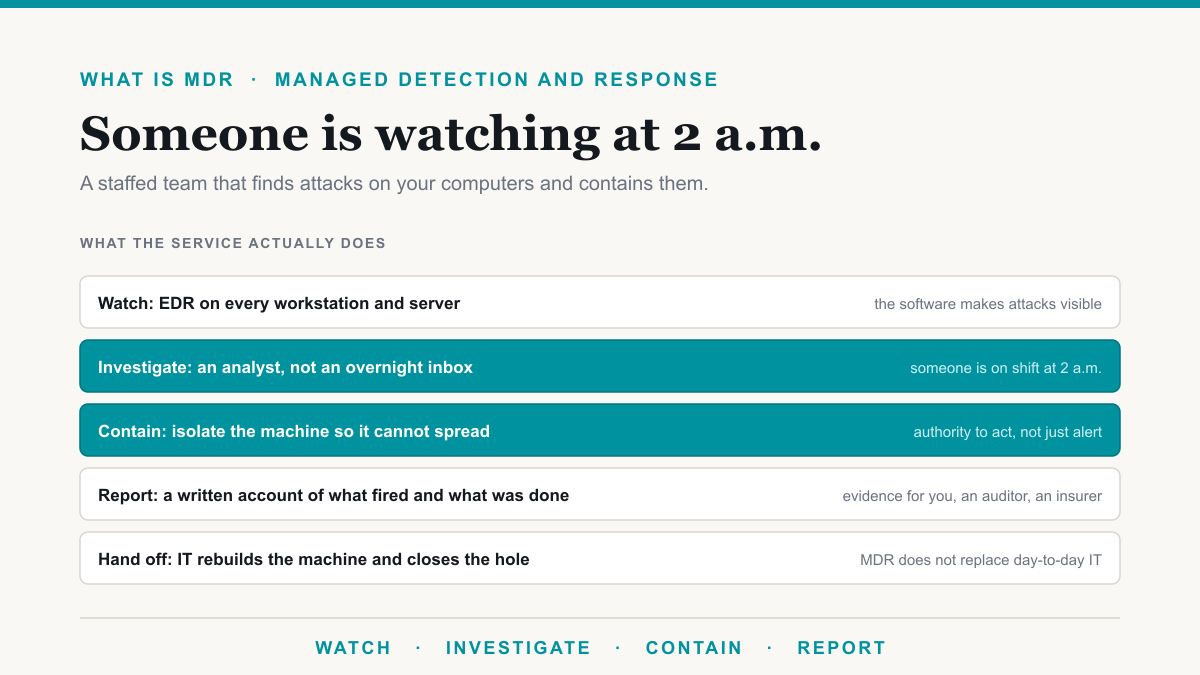
Managed Detection and Response is a service with two halves. For the definition, published cost, and the EDR comparison, start with what is MDR.
- The detection half rides on EDR, endpoint detection and response, which is software installed on each computer and server that records what programs do: what they launch, what files they touch, what they connect to.
- The response half is the part that earns the fee. When the EDR flags something suspicious, an analyst at the MDR vendor investigates it, and if it is real they act, most commonly by isolating the affected machine from the network so whatever is on it cannot spread while it gets cleaned up.
Virtually every legitimate MDR service is delivered from the vendor's own SOC. The analysts watching your endpoints sit in a security operations center; you are just not the one paying to build and staff it.
When a quote lists "24/7 SOC monitoring" and "MDR" as separate line items, ask whether those are two services or one service described twice. Often they are the same people.
The comparison that matters is build versus buy
| In-house SOC | MDR service | |
|---|---|---|
| Who staffs it | Your employees, hired and retained by you | The vendor's analysts, shared across many clients |
| How it bills | Salaries, SIEM licensing, training, turnover | A monthly fee, usually per device or per user |
| Coverage hours | Whatever shifts you can afford to staff | 24/7 by contract |
| Scope | Anything you point it at, if you build it | Defined in the agreement, typically endpoints and often Microsoft 365 accounts |
| Who it fits | Enterprises and large regulated organizations | Almost everyone else |
Once the table is in front of you, the choice mostly makes itself. A dental office in Gilbert or a law firm in Scottsdale is not going to staff a night shift of security analysts, and it does not need to. What it needs is for someone qualified to be looking when an attack starts at 11 p.m. on a Friday, because attackers show a consistent preference for hours when nobody is at the office.
What MDR does not cover
MDR finds and contains attacks. It does not run your IT, and treating it as total coverage is the most common gap we see in quotes that practices bring us to review.
- Prevention work. Patching, firewall configuration, email filtering, and access rules are what keep most attacks from landing in the first place. MDR watches for what gets through; the prevention layer still has to exist, and someone has to maintain it.
- Root-cause fixes. When MDR isolates a machine at 3 a.m., someone still has to work out how the attacker got in, close that hole, and put the machine back in service. That work usually belongs to your IT team or your managed IT company, not the MDR analyst.
- Day-to-day IT. Password resets, new hires, printers, and backups sit with managed IT services, not with the MDR desk.
- Compliance paperwork. MDR produces evidence you can point to, but risk assessments, written policies, and audit responses are separate work.
Why insurance forms and HIPAA keep bringing this up
Cyber insurance applications now routinely ask two pointed questions:
- Is EDR deployed on every endpoint?
- Does anyone monitor it around the clock?
Carriers ask because unmonitored alerts do not stop a claim from happening. A no on either question can mean a higher premium or a declined application, and a yes that turns out to be inaccurate can cause real problems when a claim is filed. If insurance requirements are part of what sent you down this road, our compliance practice deals with those questionnaires regularly.
For healthcare and dental practices there is a second driver. The HIPAA Security Rule requires covered entities to regularly review records of activity in their information systems and to have procedures for identifying and responding to security incidents. It never uses the words SOC or MDR, and it does not mandate any particular product. But a monitored detection and response service is one of the most direct ways a small practice can show that both of those things are genuinely happening rather than existing only in a policy binder.
How to buy MDR without getting burned
Four questions worth asking any vendor, including us.
- Who performs containment? Some services isolate a compromised machine themselves; others only send you an alert and wait. An alert nobody reads at 2 a.m. is not response, it is a timestamp for the incident report.
- What exactly is in scope? Endpoints only, or also your Microsoft 365 accounts? Identity attacks, where someone signs in with a stolen password instead of dropping malware, are common now, and endpoint-only coverage does not see them.
- What are the response-time commitments? Get them in the agreement, not the sales deck.
- What happens after containment? Decide in advance who rebuilds the machine and who closes the hole, so the handoff is settled before the bad night rather than during it.
For most practices in Mesa, Gilbert, Chandler, and the wider Phoenix area, MDR arrives bundled inside a broader security stack from their IT company rather than bought standalone. That is a reasonable way to buy it, as long as it appears as a named service you can point to and you know the answers to the four questions above.
Frequently asked questions
What is the difference between MDR and a SOC?
A SOC is a team of security analysts who watch systems for signs of attack around the clock. MDR is a subscription service that delivers that team from an outside vendor's own operations center. For most small and mid-sized businesses, MDR is simply how you get SOC coverage without hiring one.
Do I need both MDR and a SOC?
Usually not as separate purchases. Virtually every MDR service is run out of the vendor's own SOC, so buying MDR gives you the team and the tooling in one subscription. Large enterprises sometimes run an in-house SOC and add MDR for depth, but that is not how a smaller organization typically buys it.
Is MDR the same as antivirus or EDR?
No. Antivirus blocks known bad files on its own. EDR, endpoint detection and response, is software that records what programs do on each computer so suspicious behavior can be spotted. MDR adds the people: analysts who watch that EDR data, investigate what it flags, and contain a machine when something gets through.
How much does MDR cost?
MDR is usually priced per device or per user per month, and the total runs far below the cost of hiring even one security analyst, let alone the several needed for true 24/7 coverage. The exact number depends on how many endpoints you have and what response actions are included, so get the scope in writing.
Does HIPAA require MDR or a SOC?
Not by name. The HIPAA Security Rule requires covered entities to regularly review system activity and to have procedures for responding to security incidents, and it leaves the method up to you. Monitored detection and response is one of the most direct ways a small practice can meet both expectations.
Do cyber insurance carriers require MDR?
Many applications now ask whether every endpoint runs EDR and whether someone monitors it around the clock. Answering no can mean higher premiums or a declined application, and answering yes inaccurately can cause problems at claim time. MDR is a common and honest way to answer both questions truthfully.
Deciding between MDR and a SOC
The MDR vs SOC question mostly dissolves once you see that MDR is a SOC, rented by the month. Unless your organization is large enough to hire a shift-staffed security team, the real decisions are narrower and more useful: what is in scope, who acts when something is found, and how the detection service fits alongside the prevention and IT work that MDR does not do.
If you would like a plain read on what you have today, whether the monitoring you are paying for actually includes response, and where the gaps are, Desert Lakes Solutions offers a no-pressure discovery call to walk through it with you. Book a discovery call.