Continuous Code Monitoring: What It Is and When You Need It
Published July 5, 2026
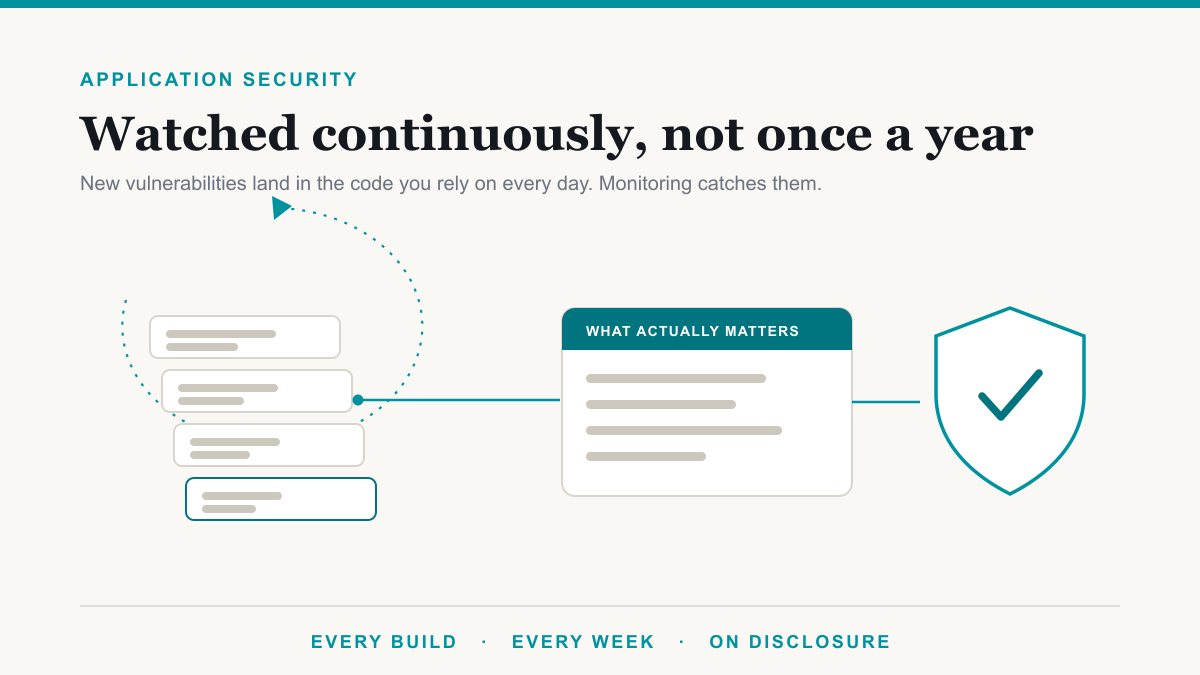
Continuous code monitoring is the practice of automatically and repeatedly scanning the software your business builds or relies on for newly discovered vulnerabilities, so a flaw disclosed today does not sit in your systems unnoticed for months. Instead of checking once a quarter or once a year, it watches on every build and on a schedule. This guide explains what it is, when your business actually needs it, and the payoff for security and compliance, written for the owner or operator who has custom software somewhere in the business and wants to know whether this belongs on their radar.
Why "continuous" matters
Modern software is mostly assembled from open-source building blocks, and the security of those blocks changes constantly. When a flaw is found in one of them, it gets a public identifier called a CVE. Here is the part that surprises people: the software you deployed perfectly clean last month can become vulnerable this month without anyone touching it, simply because a flaw was discovered in a component it already uses.
These are not rare events. More than 40,000 CVEs were published in 2024, a record, and 2025 was higher still, which is well over a hundred new vulnerabilities disclosed every day (CVE.org tracks the running totals). Most will never affect you. But you cannot know which ones do without checking, and checking once a quarter means a flaw disclosed the day after your scan can sit in your software, exploitable, for weeks or months. Continuous monitoring is simply how you keep that gap measured in days instead of months.
When your business actually needs it
Here is the honest gate, because continuous code monitoring is not for everyone. It matters when there is code that is yours to keep secure:
- You build software. A SaaS product, a mobile app, or a customer portal that your team or a contractor develops.
- You customize applications. Custom integrations, internal tools, or heavily modified platforms that handle real data.
- A framework or a customer expects it. A compliance program or a client security questionnaire that asks how you monitor your applications for vulnerabilities.
If none of those describe you, and you only use off-the-shelf software that someone else builds and hosts, then this is less about you and more about your vendors, and your own risk lives in your network, accounts, and configurations instead. In that case, a periodic security assessment of what you run is the better fit. We would rather tell you plainly that you do not need something than sell it to you.
What good monitoring actually looks like
Turning on a scanner is the easy part. The reason many businesses check quarterly instead of continuously is that raw scanners are noisy, generating duplicates and false alarms that take real work to sort out, and the output is not something a busy owner can act on. Good monitoring is defined by what happens after the scan:
- It runs for you. On every build and on a schedule, without your team standing up tools or watching a dashboard.
- The noise is cut. Someone separates the genuine, exploitable findings from the theoretical ones and ranks them by real severity, so you see a short list, not a firehose.
- The output is plain. A short report of what matters and what to do first, written to be acted on by your team or your IT provider.
- It produces proof. An evidence record you can show an auditor or a cyber-insurance underwriter.
The compliance and cyber-insurance payoff
This is where continuous monitoring earns its place for a lot of businesses. Frameworks like SOC 2 and PCI, and most cyber-insurance renewals, increasingly expect proof that you monitor for vulnerabilities on an ongoing basis, not just once before an audit. A single point-in-time scan cannot demonstrate that. Continuous monitoring produces continuous evidence, exactly the dated, ongoing record that satisfies an auditor or an underwriter. If you are already working through compliance readiness or meeting cyber insurance requirements, ongoing monitoring of your applications is often one of the boxes on the list, and having it running turns that box from a scramble into a formality.
One honest caveat worth repeating: finding a vulnerable component is only half the job. Updating a version number, or letting a bot open a pull request, does not fix anything until the change is actually built and redeployed to where the software runs. Good monitoring confirms the fix is genuinely live, not merely planned.
How we deliver it
Continuous code monitoring is specialized security work, so we run it through our dedicated security practice rather than as a generic managed-IT add-on. Our specialist team offers it as a managed service called Blindsight: it runs trusted, industry-standard scanners on your code and its dependencies continuously, triages out the duplicates and false alarms, ranks what is left by real-world severity, and hands you one plain-English report plus an audit-ready evidence bundle. It pairs naturally with a periodic penetration test, the deep look once a year, with continuous monitoring covering the many months in between. If you would rather have a broader conversation about where application security fits alongside your managed IT and compliance, that is a good place to start too.
Frequently asked questions
What is continuous code monitoring?
It is the practice of automatically and repeatedly scanning the software your business builds or relies on for newly discovered vulnerabilities, so a flaw disclosed today does not sit in your systems unnoticed for months. It runs on every build and on a schedule, rather than checking once a quarter or once a year.
Does my business need continuous code monitoring?
If you build software, customize applications, or run a custom-built portal or SaaS product, yes. If you only use off-the-shelf software and someone else builds and hosts it, this is less about you and more about your vendors. The honest test: is there code that is yours to keep secure? If so, it needs monitoring.
How is continuous monitoring different from a penetration test?
A penetration test is a periodic, hands-on assessment where a person tries to break in. Continuous monitoring is automated and always running, watching your code and its dependencies for known vulnerabilities in between those tests. They are complements. The pentest is the deep look once a year; monitoring keeps you covered the rest of the time.
How does continuous monitoring help with compliance and cyber insurance?
Frameworks like SOC 2 and PCI, and most cyber-insurance renewals, increasingly want proof that you monitor your systems for vulnerabilities on an ongoing basis. A single point-in-time scan cannot show that. Continuous monitoring produces continuous evidence, the kind of dated, ongoing record an auditor or underwriter accepts.
Isn't updating a library enough to fix a vulnerability?
Not on its own. Changing a version number, or letting a bot open a pull request, only proposes the fix. The vulnerability is closed only when the updated code is installed, the software is rebuilt, and the new build is redeployed. Good monitoring confirms the fix is actually live, not just planned.
Deciding if continuous code monitoring is right for you
Continuous code monitoring earns its place when your business has software it is responsible for keeping secure, and it pays off twice: fewer surprises from a vulnerability you did not know you had, and the ongoing evidence that auditors and insurers increasingly ask for. If you are not sure whether you have code that needs watching, or how it fits alongside your managed IT and compliance work, Desert Lakes Solutions is glad to talk it through on a no-pressure call and point you to the right level of coverage. Get in touch here whenever you are ready.