Zanus AI for LLM Hosting: What It Takes to Put a Private AI Server in a Phoenix Office
Published September 1, 2026
Zanus AI sells a quote-only, on-premises private AI server, and putting one in a Phoenix office means solving power, cooling, network, sign-in, backup, and document prep before the box does anything useful. Done right, you get a private model that answers from your own files without sending a word to a cloud chatbot, on hardware you can walk up to. This is for owners and office managers in healthcare, legal, finance, and professional services who have seen a Zanus AI pitch and are now searching for LLM hosting for business to work out what they would actually be buying.
This is the view of a Phoenix managed IT provider that specs, racks, powers, and manages servers for a living, written from what Zanus publishes on its own site as of September 1, 2026. Where the site is silent, we say so rather than guess.
What Zanus AI actually sells
Zanus AI is a Florida company that sells three tiers of private AI server: Prime for smaller teams, Quantum for multi-user document search and workflows, and Enterprise Cluster for high concurrency. Every unit is "custom configured to your exact needs" and priced by quote after a demo, per the Zanus AI private AI servers collection. The pitch is a flat price with unlimited users, multiple large language models built in, and "15+ business modules" such as AI chat, client management, scheduling, document generation, marketing automation, and web chatbots. The company describes the systems as HIPAA, GDPR, SOC 2, and EU AI Act ready and lists trade-show awards from CES 2026 and ISE 2026.
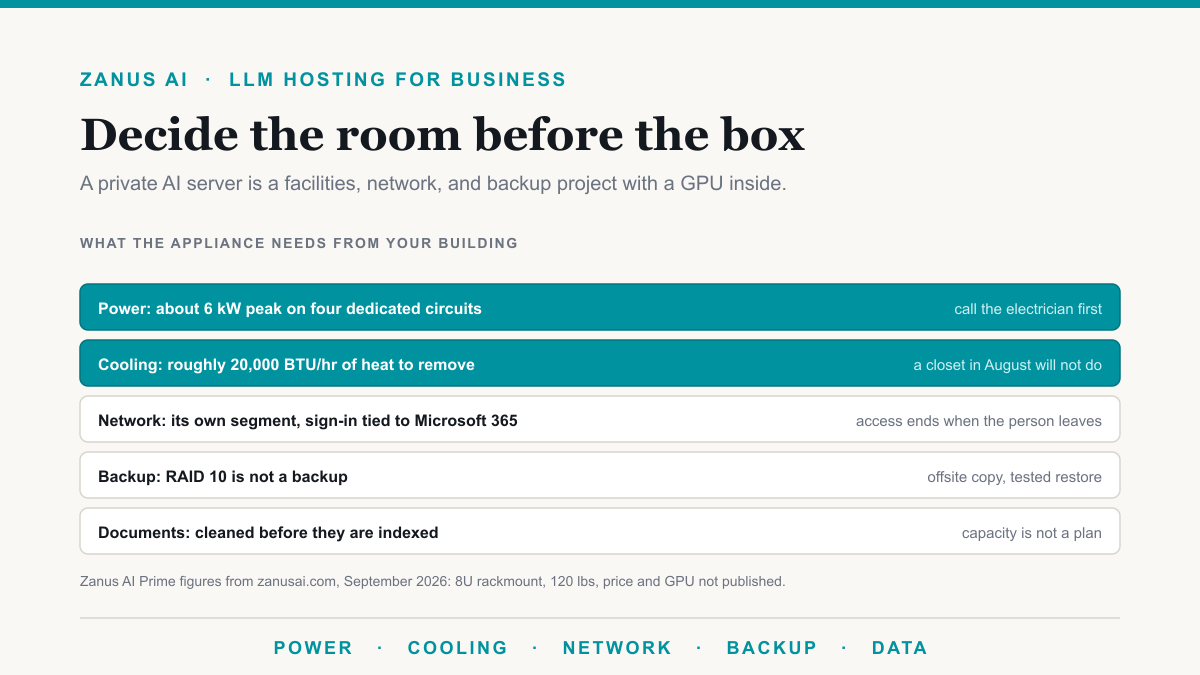
The Zanus AI Prime product page is the only place hard numbers appear. It is an 8U rackmount unit, 19 inches wide, weighing 120 pounds, with RAID 10 NVMe storage, rated for "2,000,000+ documents and 50,000+ hours of video." Power is four standard AC circuits, autoranging 90 to 240 volts, at roughly 6 kilowatts peak and 1 kilowatt idle. That is the full public spec. Here is what it leaves out.
| Published by Zanus AI | Not published |
|---|---|
| Three tiers and who each is for | Price for any tier |
| 8U rackmount, 120 lbs, RAID 10 NVMe | GPU model, GPU memory, CPU, RAM, usable storage |
| About 6 kW peak, 1 kW idle, four circuits | Which language models ship on it and how they are updated |
| "15+ business modules," "multiple LLMs built-in" | Warranty length, replacement lead time, support hours |
| HIPAA, GDPR, SOC 2, EU AI Act "ready by design" | Whether the company signs a business associate agreement |
None of that makes Zanus a bad product. It means the buyer has to supply the questions, and it means the deployment work around the box is yours no matter who sells it.
The room: 6 kilowatts is a building problem
Six kilowatts at peak is why Zanus specifies four dedicated circuits. A standard office outlet circuit cannot carry that load, so the first vendor on this project is an electrician, not an AI company. Nearly all of the power a server draws leaves the box as heat. One kilowatt is about 3,412 BTU per hour, so 6 kilowatts is roughly 20,000 BTU per hour that something has to remove from the room. That is more than a one-and-a-half-ton air conditioner handles, running into a closet, in Phoenix, in August.
The idle figure matters too. At about 1 kilowatt around the clock, the unit uses roughly 730 kilowatt-hours a month before anyone asks it a question. Multiply that by your APS or SRP commercial rate for the standing cost. At 120 pounds and 8U tall, it also needs a proper four-post rack, not a shelf in the supply room.
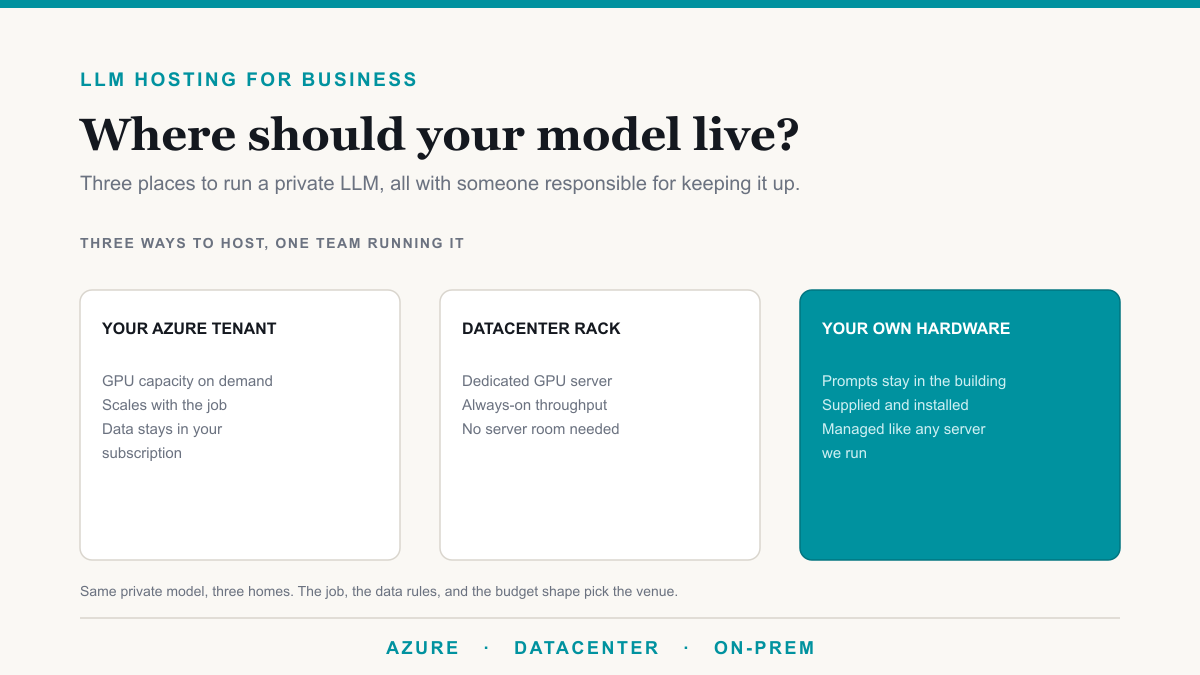
If your building has a room with that power and cooling, good. If it does not, the same private model can live in a Valley datacenter rack or in your own Azure tenant, which we cover in LLM hosting in Phoenix. Choosing the venue before signing for hardware is the cheapest decision in the whole project.
Network and sign-in: the box holds everything
A server that indexes two million of your documents and answers questions about them is the most convenient search tool in the building for anyone who reaches it, so it needs tighter access rules than a file server, not looser ones. Put it on its own network segment behind the firewall, allow only the people and systems that should reach it, and keep its management interface off the internet. If the vendor connects for remote support, document how that connection works and make sure you can turn it off. This is standard work under our security services, and it should be finished before the first document is loaded.
Sign-in should follow your Microsoft 365 accounts. When someone leaves the practice, their access to the AI server should end the same day their email does, without a separate password list to remember. Zanus AI does not say on its site whether the modules support single sign-on with Microsoft 365 or Google Workspace. Ask, and get the answer in the quote.
Backup and the day it fails
RAID 10 protects against a disk failing. It does not protect against the whole unit failing, a bad update, ransomware, a lightning strike on those four circuits, or a fire. The things on that box that exist nowhere else are the indexed document store, the module configuration, chat history, and every document the system generated. Back them up off the box and offsite, and test a restore before you rely on it.
Because Zanus publishes no warranty or lead time, ask what happens on the morning after a failure. Is there advance replacement? Depot repair? Who reloads the data, and how long does the office go without the tool it now depends on? Those answers belong in the same recovery plan as your line-of-business systems, because that is what this server becomes the week it starts answering questions well.
Document prep: two million documents is a capacity, not a plan
The model answers from what you feed it. Feed it a decade of duplicates, superseded drafts, and folders half the company should never have been able to open, and you get confident answers from the wrong version of the wrong file. The cleanup is the same one a Microsoft 365 Copilot rollout needs: retire old versions, remove duplicates, fix over-shared folders, and decide what is in scope at all. HR files, payroll, and legal holds usually are not.
For a medical or dental practice, the scope decision is also a HIPAA decision. The HIPAA Security Rule expects access to electronic protected health information to be limited to the people and systems that need it, and a search box over the whole practice cuts against that unless the source permissions are right first. A vendor's "HIPAA ready" label describes the product. The compliance work is how you run it.
What to ask for in the Zanus AI quote
Because the public site answers almost nothing, the quote has to. Ask for each of these in writing before you compare Zanus to any other option.
- GPU model, GPU memory, and how many cards. This decides which models fit and how many people can use it at once.
- Which language models are installed, who updates them, and how often. A model frozen at purchase ages quickly.
- CPU, RAM, and usable storage after RAID 10. RAID 10 uses half the raw disk for mirroring.
- Warranty length, replacement lead time, and whether a spare is available.
- Support hours, how remote support connects, and whether you can disable it.
- Any recurring fee for software modules, model updates, or licensing, and the term it is locked for. The site says flat price and unlimited users. Get that on paper.
- Single sign-on with Microsoft 365 or Google Workspace for every module.
- Exit terms. How you get your documents, index, and generated content out if you stop using it.
- For healthcare, a business associate agreement covering any vendor access to the system.
Where a local managed IT team fits
Everything above except the appliance itself is ordinary managed IT, and it is what Desert Lakes Solutions does for Phoenix businesses and nearby Scottsdale, Tempe, Mesa, and Chandler. We assess the room and spec the power and cooling with your electrician, supply and install the rack, build the network segment and firewall rules, connect sign-in to Microsoft 365, set up backup and monitoring, and clean up the documents before they are indexed. When the unit needs hands, we drive to it. That is the same managed IT we provide for every other server in your building.
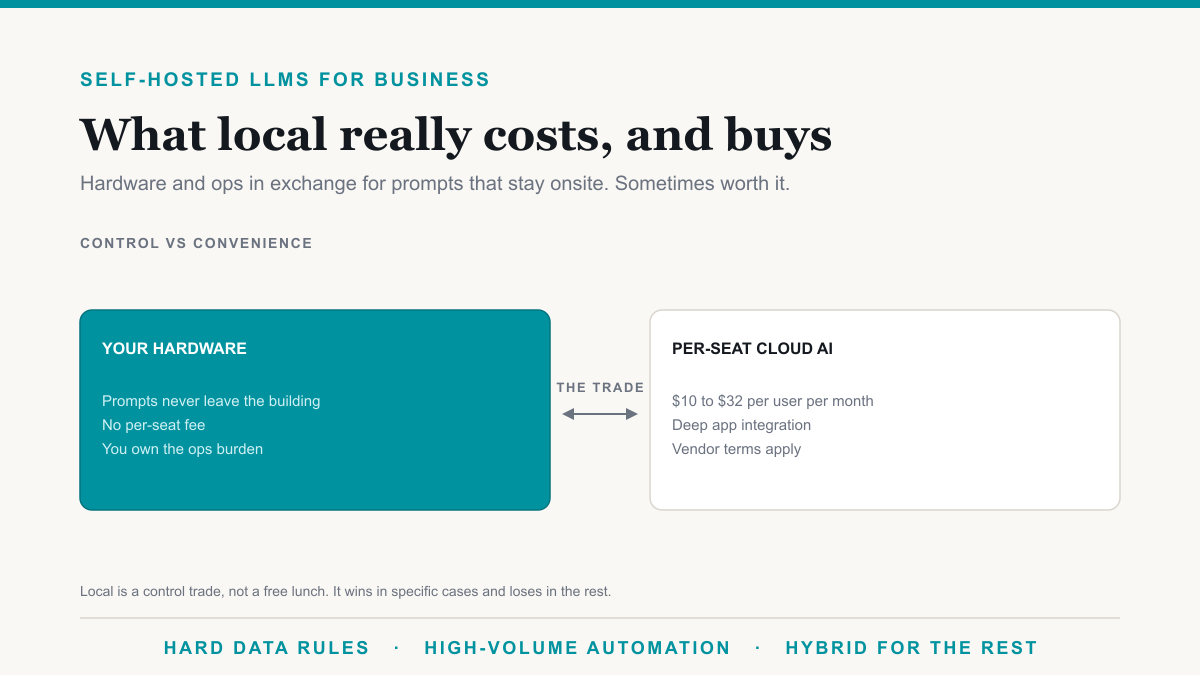
If the room cannot take 6 kilowatts, or you would rather not own 120 pounds of hardware, the same private model can run in a datacenter rack or your Azure tenant, and we manage those too. The trade-offs are in LLM hosting for business. We already run local models in production as the supervisor on client automation, so this is work we do, not a service we are describing.
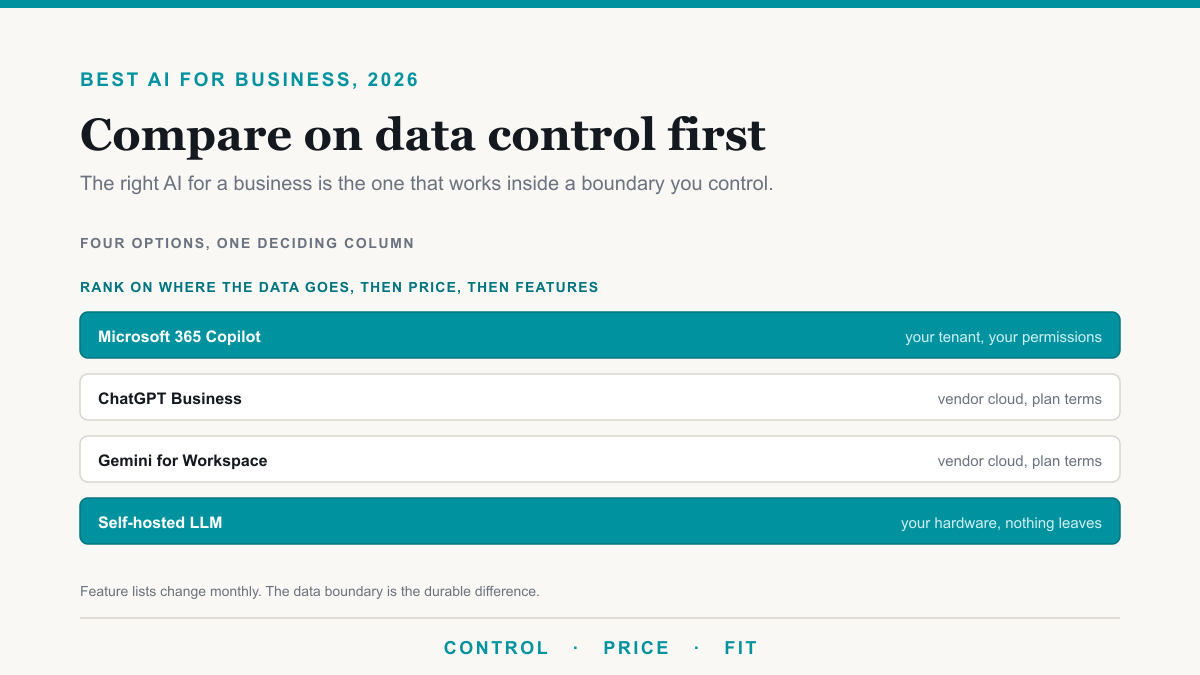
On price, we do not publish a rate card for LLM hosting because hardware and cloud rates move too fast for a blog post to stay honest. The cost shape holds still: a hardware purchase plus monthly management for an office box, a fixed monthly bill for a datacenter rack, usage-based billing in Azure. For staff who mainly want help in Word and Outlook, Microsoft 365 Copilot runs about $23.50 to $32 per user per month on the current Business bundles, verified against Microsoft's pricing in August 2026. Many offices end up with Copilot for everyday work and a private model for the files that cannot leave the building, and the two run fine side by side.
Frequently asked questions
What is Zanus AI?
Zanus AI is a Florida company that sells on-premises private AI servers in three tiers, Prime, Quantum, and Enterprise Cluster, each custom configured and priced by quote. The servers ship with multiple built-in language models and a bundle of business software modules. The company publishes size and power figures for the Prime unit but not the GPU, the model names, or the price.
How much does a Zanus AI server cost?
Zanus AI does not publish prices. Every server is quoted after a demo, and warranty and support terms arrive with that quote. Before you compare it to anything, ask for the GPU model and memory, which language models are installed, the warranty length, the support hours, and any recurring software fee. Those five answers turn a quote into a number you can evaluate.
Can a small office run a Zanus AI server?
Sometimes, if the room is built for it. The Prime unit draws about 6 kilowatts at peak across four dedicated circuits and weighs 120 pounds, so it needs a real rack, an electrician, and dedicated cooling. Many Phoenix offices do not have that closet. If yours does not, the same private model can run in a datacenter rack or your Azure tenant instead.
Do I still need IT support if I buy a Zanus AI server?
Yes. The appliance handles the model. Someone still has to power and cool it, put it on its own network segment, connect sign-in to your Microsoft 365 accounts, back up what it holds, watch for failures, and prepare the documents you feed it. That is ordinary server work, and it decides whether the box is useful on day one or sits idle.
Is Zanus AI HIPAA compliant?
Zanus AI describes its servers as HIPAA, GDPR, SOC 2, and EU AI Act ready. Readiness is a product claim. Compliance is how your practice runs the system: who can sign in, what gets logged, how it is backed up, and whether vendor remote support touches patient data under a business associate agreement. An on-premises box helps with that work. It does not do it for you.
Zanus AI for LLM hosting: decide the room before the box
Zanus AI for LLM hosting is a reasonable thing to evaluate if you have the room, the questions, and someone to run everything around the appliance. Settle the venue first, get the missing specs and terms into the quote, and treat the server like the critical system it becomes. If you would like a second set of eyes on a Zanus quote, or a look at whether your office can take the power and heat, Desert Lakes Solutions offers a no-pressure discovery call to walk through it against your actual building and files. Book a discovery call.