Your IT Company Was Acquired by Private Equity. Should You Leave?
Published August 10, 2026
Not on its own. An acquisition by itself is not a reason to leave your IT company, and in plenty of cases the service you get next year looks a lot like the service you got last year. What matters is the twelve months after the announcement, because that is when a new owner's plan starts showing up in your response times, your invoice, and the name of the person who answers your ticket. This is for the owner or office manager who just got the "exciting news" email from their IT provider and wants to know whether to sit tight, ask harder questions, or start looking. Below is what usually changes and when, the signs worth watching, the nine questions to ask this week, what your contract probably says, and what leaving actually costs if it comes to that.
Should we leave if our IT company was acquired by private equity?
Decide on evidence, not on the announcement. The useful move in the first week is to write down what your service looks like right now, while you still remember it clearly, and then set a date about ninety days out to compare. Most people skip that step, and six months later they can feel that something got worse without being able to say what.
Three numbers are worth capturing today:
- Your current response time on something urgent. Not the number in the contract. The number you actually get.
- Who you call, by name. The technician or account manager who already knows your environment.
- What you pay per user per month, all in. Include licensing, backup, security, and anything billed separately.
Those three are what an integration tends to move, in that order. If all three still hold at your renewal, the acquisition was mostly a change of letterhead. If two of the three have slipped and nobody told you in advance, you have your answer without needing to guess at anyone's motives.
Why is this happening to so many IT companies?
Because the industry is in an active consolidation cycle, and small profitable IT firms are attractive to buy. Managed services revenue is contracted and recurring, which is exactly the kind of predictable income an acquirer will pay a premium for. Investment bank Drake Star counted 466 investment and acquisition transactions involving managed service providers in 2025, up roughly 20 percent from 389 the year before, with 123 of them landing in the fourth quarter alone. Of the 466, some 420 were mergers and acquisitions, carrying $4.3 billion in disclosed deal value against $3.7 billion in 2024. The same report puts the global managed services market at $350 billion in 2025 and growing toward $850 billion by 2034, and notes that each of the ten most active strategic buyers has closed at least five provider acquisitions since January 2024.
A managed service provider, or MSP, is simply the outsourced IT company that runs your help desk, your network, and your security for a monthly fee. When one gets bought, the buyer is usually one of two things: a larger provider expanding its footprint, or an investment firm assembling several providers into a single larger business, which the industry calls a roll-up.
Neither is sinister, and both are ordinary in a maturing industry. What is worth understanding is what the new owner is measuring. Acquirers in this sector underwrite profitability and repeatability, and the benchmark is public: Service Leadership, the benchmarking arm of ConnectWise, reported that 2024 marked a fifth consecutive year in which best-in-class technology solution providers cleared 19 percent adjusted EBITDA, a standard measure of operating profit, while revenue growth among managed service providers slowed to 7.1 percent.
Read those two figures together and the integration playbook stops being mysterious. When growth is slow and the profit target is high, the fastest levers are standardizing tools, consolidating staff, and repricing contracts at renewal. That is not a scandal. It is arithmetic, and it explains why the changes you are about to see tend to arrive in a particular order.
What actually changes after an IT company is acquired?
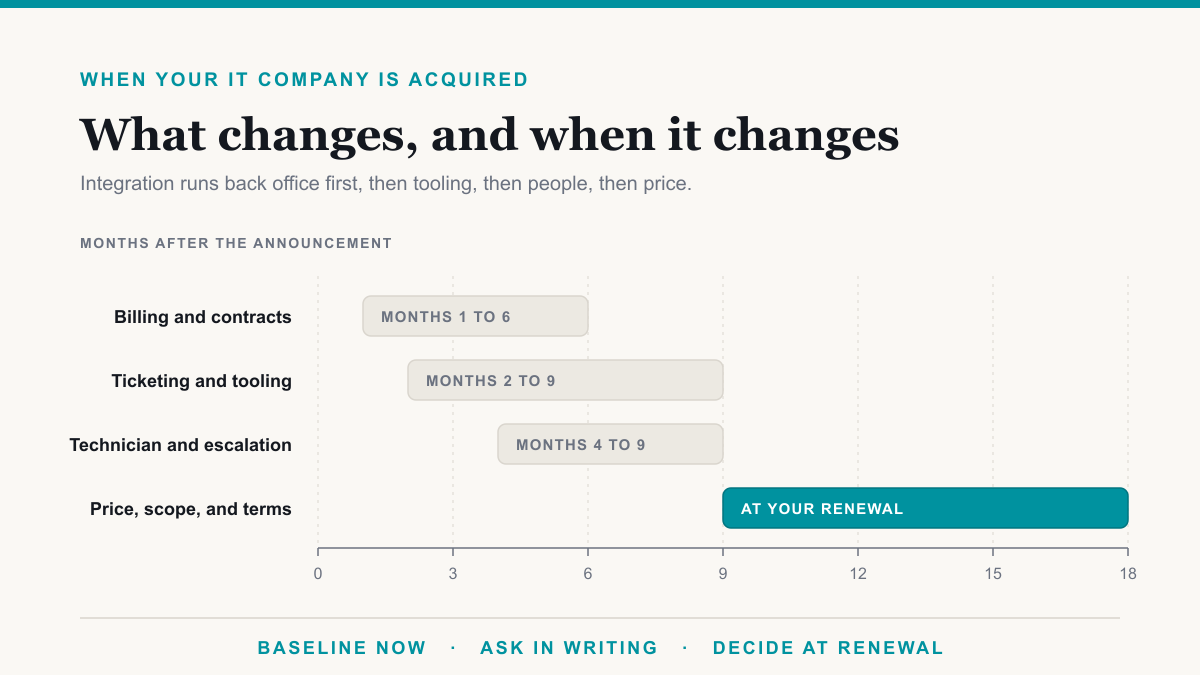
Integration usually works from the back office outward, because that is where the savings are easiest and the customer complaints are quietest. Here is the sequence most clients experience, and what each stage looks like from your desk.
| What changes | Typical timing | How you notice |
|---|---|---|
| Billing, invoicing, and the entity on your contract | First 1 to 2 quarters | A new invoice format, a new remit-to address, a request to re-sign paperwork |
| Ticketing system and support email address | First 2 quarters | Your old support address bounces or forwards; ticket history does not come across |
| Monitoring, antivirus, backup, and security tooling | 2 to 4 quarters | New agents installed on your computers, sometimes with little notice |
| Your named technician and account manager | 2 to 4 quarters | Unfamiliar names on tickets, and repeating context you used to not have to repeat |
| Escalation path and after-hours coverage | 2 to 4 quarters | Calls routed to a central desk instead of the person who knows your site |
| Price, scope, and contract terms | At your renewal | A higher per-user rate, a longer term, or items that used to be included now billed separately |
None of these are guaranteed. Plenty of acquisitions leave the local team and the local pricing alone for years, particularly when the buyer bought the team precisely because it was working. The point of the table is that if changes come, they tend to come in this order, so the early ones are your advance notice for the later ones.
What changes in the first 100 days, and what takes a year?
The first hundred days are mostly administrative and mostly harmless. The second and third quarters are where service quality is actually decided.
- Weeks 1 to 4. Announcement emails, leadership introductions, reassurance that nothing will change. Usually accurate at the time it is written.
- Months 2 to 4. Back-office consolidation. Billing, contracts, ticketing, and phone systems move onto the parent's platforms.
- Months 4 to 9. Tooling standardization and staffing decisions. This is the window where your technician gets reassigned and where your monitoring stack gets swapped.
- Months 9 to 18. Commercial changes at renewal. New rate, new term, new scope.
- Anytime. Founder departure. Owners typically stay through an earn-out period, and their exit is often the clearest signal that the original operating style is gone.
Six signs the acquisition is going badly for you
These are the ones worth acting on, as opposed to the ones that are merely annoying.
- Nobody knows your environment anymore. You are explaining your own server, your own line-of-business software, or your own building to a new person every few tickets.
- Response times slipped and nobody acknowledged it. Slower is survivable. Slower with no explanation and no revised commitment is a service problem the new owner has decided not to discuss.
- Your escalation path is now a queue. The number you used to call for something urgent goes to a general desk that opens a ticket and calls you back.
- Tooling changed without a maintenance window. New agents pushed onto your machines during business hours, without notice, means change control at the parent is weak. That is a risk that lands on you eventually.
- Documentation and passwords went quiet. Requests for your own credential documentation start taking weeks, or get answered with a support ticket instead of a document.
- The renewal arrives as a fait accompli. A materially higher price, a longer term, and a short window to sign, with no conversation beforehand.
One of these is a bad quarter. Three or more, sustained past a renewal, is a different company than the one you hired.
What does it look like when the acquisition goes well?
This part gets left out of most articles on the subject, and it matters if you are trying to make a fair decision. Scale genuinely buys some things a ten-person IT company cannot afford on its own.
- Real after-hours coverage. A round-the-clock staffed desk instead of one person's cell phone.
- Security capability you did not have. A staffed security operations center, proper monitoring, and someone who watches alerts at 2am.
- Depth behind your technician. Specialists for networking, cloud, and compliance rather than one generalist covering all three.
- Process where there was improvisation. Documented onboarding, real change control, and a ticket system that does not lose things.
If your local team is intact, your pricing held, and you gained coverage you were previously paying a single person to approximate, the acquisition worked in your favor. Say so, and stop worrying about it.
What should I ask my provider this week?
Send these in one email and ask for written answers. How quickly and how specifically they respond tells you nearly as much as the answers do.
- Which legal entity holds our agreement now, and do we need to sign anything?
- Is our pricing changing, and if so, when and by how much?
- Who is our named technician and account manager as of today, and are they staying?
- Is our escalation path and after-hours number changing?
- What tooling are you replacing on our systems, and on what schedule?
- Where does our documentation and password vault live now, and how do we get a copy?
- Are our backups moving to a different platform or a different tenant?
- Who bills our Microsoft 365 licensing after the transition?
- Is our current agreement's notice period and termination language unchanged?
Two answers deserve extra attention. If they will not put pricing intentions in writing, assume the renewal is where the change lands. If they cannot say who your named technician is, the staffing decisions have already been made and not yet communicated.
Does our contract survive the acquisition?
In most cases yes, and often without needing your signature. Managed services agreements commonly include an assignment clause that lets the provider transfer the contract as part of a sale or merger. Whether your consent is required, and whether you get a right to terminate when control changes, is decided by the wording in your specific agreement. Read it, or have your attorney read it, and look for three things: the assignment language, the notice period for cancellation, and whether you have a termination for convenience right.
That last one is where the cost of leaving is set. A law firm that works in this space, Scott and Scott LLP, describes termination for convenience as the customer's right to exit for reasons other than a failure by the provider, notes that sixty days is a usual cancellation window, and recommends to providers that 50 percent of the remaining fees be paid at early termination. Treat that 50 percent figure as what providers are advised to ask for rather than a market standard, and check what your own agreement actually says.
Healthcare has an extra step. If your IT provider handles protected health information, it is a business associate, and 45 CFR 164.504(e) governs what that contract has to require, including returning or destroying protected health information at termination if feasible, and continuing to protect whatever cannot be returned or destroyed. After an acquisition, confirm in writing which legal entity now holds your business associate agreement, and get a fresh one signed if the entity you originally contracted with no longer exists. Practices working through this alongside an audit or an insurance renewal can find the broader control list on our compliance page.
What happens to our Microsoft 365 licensing?
It depends on how you buy it. If your licenses sit on your own bill, nothing needs to move. If you buy them through the provider's cloud solution provider agreement, that billing relationship can transfer to the acquiring company, and your licensing invoice will come from a different business.
You can check the access side yourself in about a minute. In the Microsoft 365 admin center, open Settings, then Partner relationships, to see which partners hold delegated administrative rights to your tenant, meaning the ability to administer your environment from outside it. Microsoft documents how to review partner administrative privileges and how a delegated admin relationship is ended. Note Microsoft's own caution that removing partner roles does not by itself remove a partner's ability to make purchases on your behalf, which has to be handled separately in Partner Center.
Ask for both answers in writing, because they can differ: one entity may bill you while another holds admin rights during a transition.
When is leaving the right call?
Three situations justify moving, and none of them is the acquisition itself.
- Service degraded and the conversation about it went nowhere. You raised it, you got acknowledgment without a plan, and the next quarter looked the same.
- The commercial terms no longer match what you get. A significant increase without added scope, particularly paired with reduced local coverage.
- Your risk went up and nobody owns it. Backups moved and nobody has tested a restore, security tooling changed and nobody documented it, or your compliance paperwork is now stale.
A fourth situation is quieter and worth naming: your business changed, the acquisition simply prompted you to look, and the provider you hired at eight people is not the right fit at thirty. That is a legitimate reason to shop, and it has nothing to do with who owns them.
What does it cost to switch if we decide to go?
Two costs, and they are separate. The first is contractual, which is the notice period and any early termination fee described above. The second is the new provider's rate, which you can compare directly if they publish one.
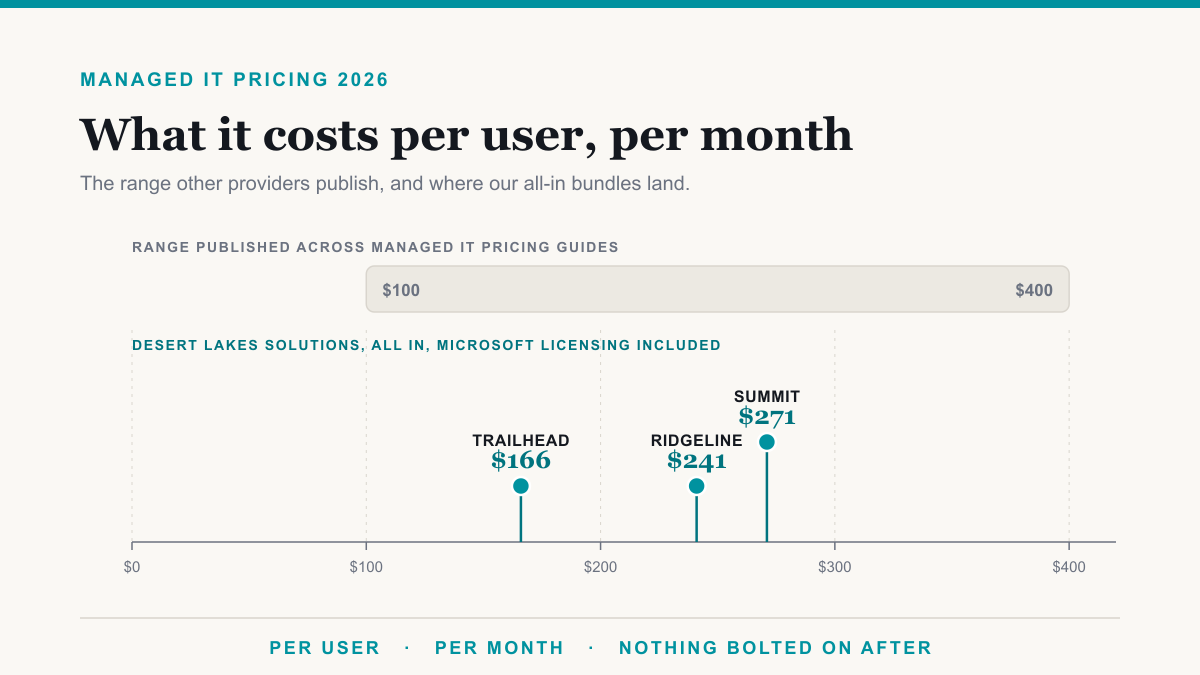
Ours is published. Managed IT at Desert Lakes Solutions runs $166 per user per month on Trailhead, $241 on Ridgeline, and $271 on Summit, all in with Microsoft licensing, against a $1,400 monthly minimum. Volume discounts step in at 4 percent for 25 users, 5.5 percent at 50, and 10 percent at 100. A 15-minute response standard on critical issues applies at any hour on every tier, while help desk staffing is business hours on Trailhead and around the clock on Ridgeline and Summit. Summit includes virtual CIO advisory up to six hours a month, with overage quoted. Employee onboarding and offboarding are billed per staff event at $150 and $75. Most clients are fully onboarded within two to three weeks. The full rate card and a calculator are on our pricing page.
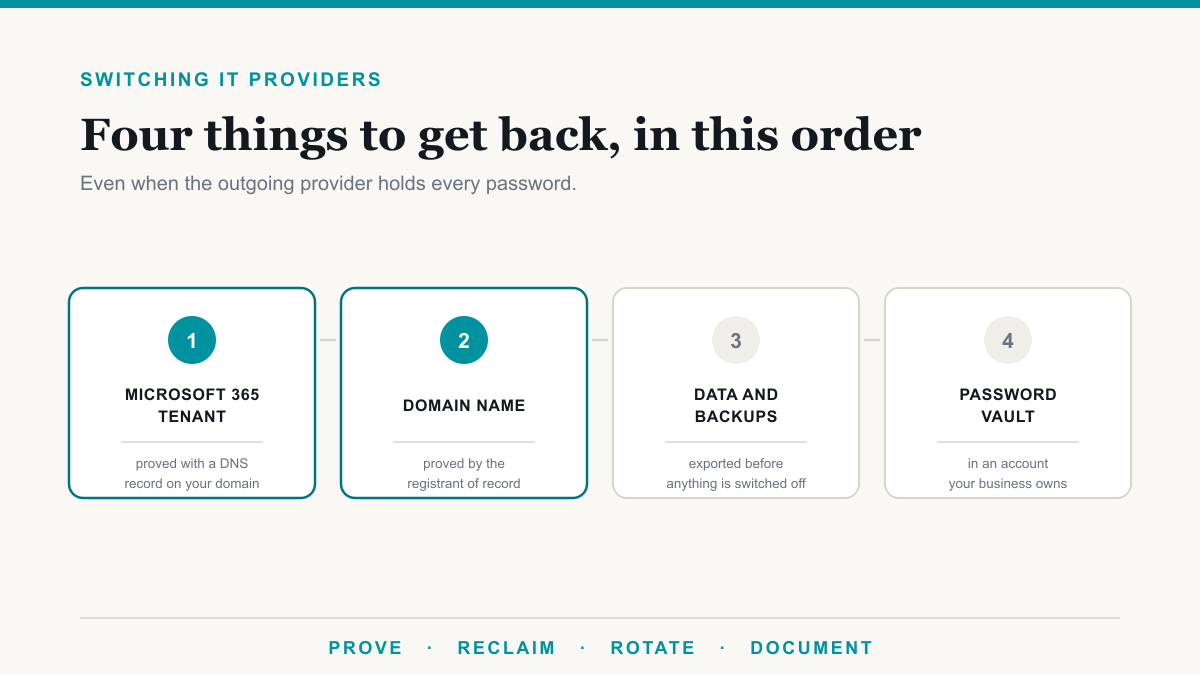
For a benchmark against the rest of the market before you compare anything, see our breakdown of what managed IT should cost per user per month. For the mechanics of an actual move, including the case where the outgoing provider holds every password, see how to switch IT providers. If you are weighing whether to bring any of this in-house instead, the arithmetic is in our in-house versus managed IT comparison.
What to do in the next two weeks
- Write down the three baseline numbers. Real response time, named technician, all-in cost per user. Date the note.
- Send the nine questions and ask for written answers.
- Pull your agreement and find the assignment clause, the notice period, and the termination language.
- Check Partner relationships in the Microsoft 365 admin center and record who holds delegated admin rights today.
- Confirm a backup restore has been tested since the acquisition, and get the result in writing.
- Set a ninety-day review on your calendar, and a second one two months before your renewal date.
That is roughly two hours of work, and it converts a decision you would otherwise make on instinct into one you can make on evidence.
Frequently asked questions
Should we leave our IT provider just because it was acquired?
Not on the news alone. An acquisition is a reason to start measuring, not a reason to give notice. Set a review date about ninety days out, write down what good service looks like today, and judge the new owner on what actually happens to your response times, your account team, and your renewal. Leave on evidence.
How common is it for an IT company to be acquired?
Common and rising. Drake Star counted 466 investment and acquisition transactions involving managed service providers in 2025, up about 20 percent from 389 in 2024, with 420 of those being mergers and acquisitions worth $4.3 billion in disclosed value. Its top ten most active strategic buyers each closed at least five deals since January 2024.
What usually changes after an IT company is acquired by private equity?
The pattern is back office first, then tooling, then people, then price. Billing systems and contracts tend to move within a quarter or two. Monitoring and security tools get standardized onto the parent's stack. Your named technician may be reassigned as teams merge. Price changes usually arrive at your renewal rather than mid-term.
Can our contract be transferred to the company that bought our IT provider?
Usually yes. Most managed services agreements contain an assignment clause that lets the provider transfer the contract as part of a sale, sometimes without your consent. Read your own agreement, or have your attorney read it, and specifically look for the assignment language, the notice period, and any termination for convenience right.
What happens to our Microsoft 365 licensing if our IT provider is acquired?
If you buy licenses through the provider's cloud solution provider agreement, that billing relationship can move to the acquiring company. In the Microsoft 365 admin center, open Settings, then Partner relationships, to see which partners hold delegated administrative access to your tenant. Ask in writing which legal entity will bill you and which will hold admin rights.
How much notice do we have to give to leave an IT provider?
Check the agreement rather than assuming. Sixty days is a common cancellation window in managed services contracts, and many agreements also carry an early termination fee if you leave before the term ends. Some providers are advised to charge half the remaining contract value, so read the term, the notice period, and the fee together.
Is Desert Lakes Solutions private-equity backed?
No. Desert Lakes Solutions is independently owned and is not backed by private equity or part of a roll-up. No IT company can honestly promise its ownership will never change, which is why the checks in this article are worth applying to any provider you are considering, including us.
Deciding after your IT company was acquired by private equity
The announcement is not the event. The renewal is. Between now and then you have time to capture a baseline, get written answers to nine questions, read your own contract, and watch what happens to the three things an integration usually moves. If they hold, stay, and stop spending energy on it. If they slip and nobody will discuss it, you will be leaving with a documented reason rather than a bad feeling, which also makes the conversation with your next provider a lot shorter.
If you would like a second opinion on what you are getting today, Desert Lakes Solutions offers a no-pressure discovery call to walk through your current setup, your contract, and where the gaps are, whether or not you end up moving. We work with businesses across Phoenix and the East Valley, and you can see what is covered on our managed IT page. Book a discovery call.