Tesla Fleet API Pricing: Streaming vs Polling
Published July 18, 2026
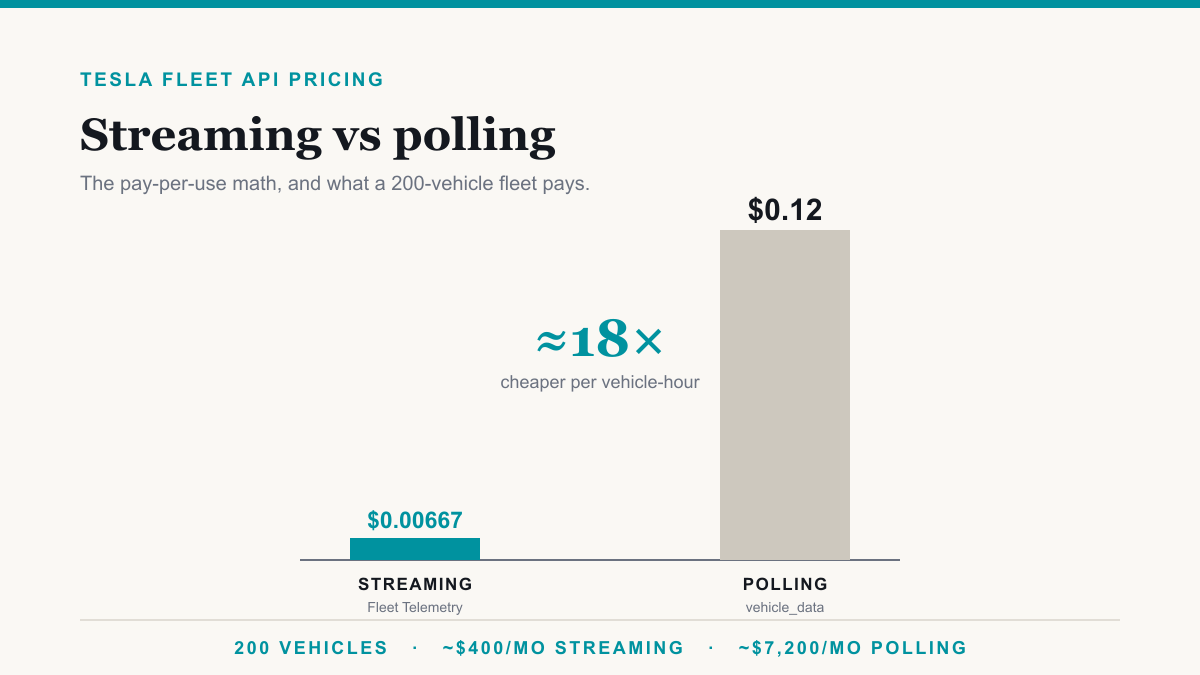
Tesla Fleet API pricing comes down to one choice: streaming telemetry costs about $0.00667 per vehicle-hour, while polling the same data over the REST API costs about $0.12 per vehicle-hour, roughly eighteen times more. For any fleet beyond a handful of vehicles, that difference decides the architecture, because it is the gap between a monitoring bill in the hundreds of dollars a month and one in the thousands. This post is for the team pricing out a Tesla integration and trying to understand what they will actually pay, and it walks through how Tesla bills, what each approach costs, and what a 200-vehicle fleet looks like on paper each way.
The numbers here come from Tesla's own Fleet API billing documentation. Rates change over time, so treat these as the current shape of the pricing rather than a permanent quote, and confirm the live figures before you budget.
How Tesla bills the Fleet API
Tesla moved the Fleet API to pay-per-use pricing, which means you are billed for what you actually consume rather than a flat subscription. There are a few separate meters, and it helps to know which is which:
- Streaming signals. When a vehicle streams telemetry, you are billed per signal, and signals are only sent when a value changes. Tesla prices this deliberately low to reward efficient, event-driven designs. The effective rate works out to roughly $0.00667 per vehicle-hour of active streaming.
- Data requests. Pulling a vehicle's full data snapshot from the vehicle_data endpoint is a paid call. Poll it about once a minute for an hour and you are around $0.12 per vehicle-hour.
- Commands and wakes. Sending a command to a car, or waking a sleeping one so you can reach it, are billed separately again. Telemetry-only fleets that never send commands avoid most of this.
- The monthly credit. Every account gets a $10 monthly credit. That comfortably covers a hobbyist running one or two cars, but at fleet scale it is a rounding error.
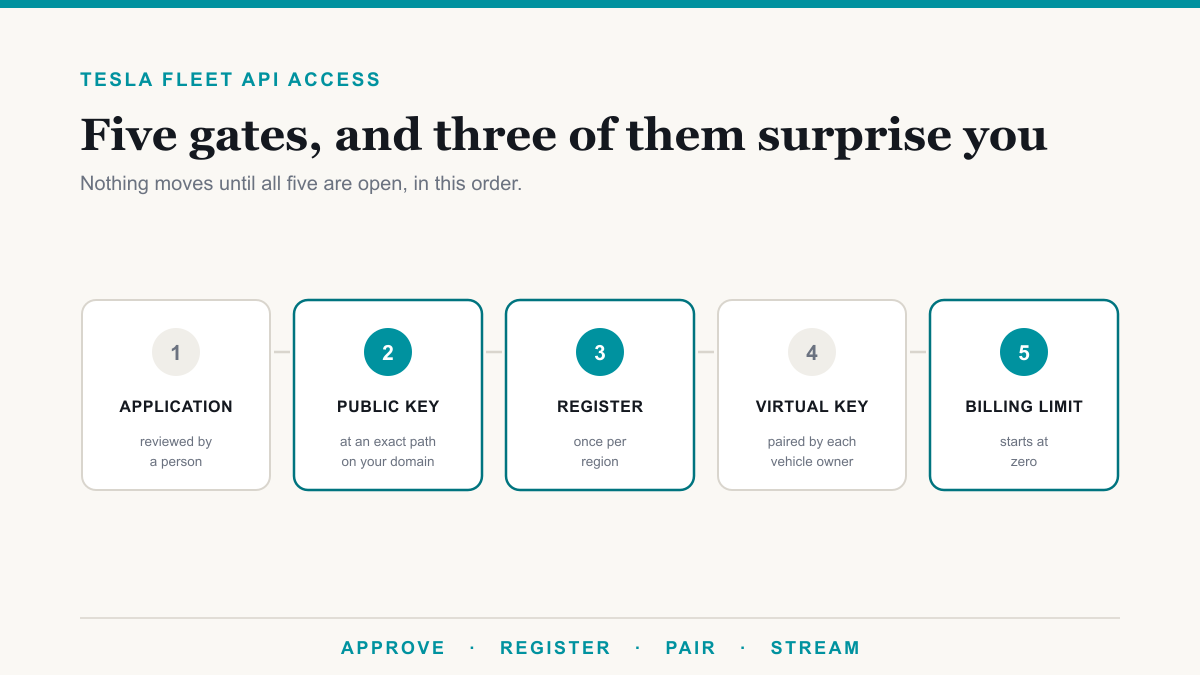
The key idea baked into the pricing is that streaming is cheap because it only moves data that changed, while polling is expensive because it pays for a full snapshot every single time, whether anything moved or not. If your account is not set up yet, our guide to Tesla Fleet API access walks the approval and registration sequence, including the billing limit that starts at zero.
Streaming versus polling, side by side
Streaming and polling are two genuinely different models, and Tesla prices them to push you toward streaming. Here is the comparison at the level that matters for cost:
| Streaming (Fleet Telemetry) | Polling (vehicle_data) | |
|---|---|---|
| How you get data | Vehicles push changes to your server | You request the full snapshot on a schedule |
| Rough price | ~$0.00667 per vehicle-hour | ~$0.12 per vehicle-hour (about 1 request/min) |
| You pay when | A signal value changes | Every request, changed or not |
| Near real time | Yes, down to seconds | Only by polling faster, which costs more |
| Idle vehicles | Cost almost nothing | Cost the same as active ones |
That last row is easy to overlook and matters a lot for a real fleet. Vehicles spend most of their lives parked. A streaming design pays almost nothing while a car sits still, because nothing is changing. A polling design pays the same $0.12 an hour to ask a parked car the same question sixty times an hour and get the same answer.
What a 200-vehicle fleet costs each way
Rates per vehicle-hour are hard to feel, so put them against a real fleet. Take 200 vehicles and two honest reporting profiles: one where each vehicle is active and reporting about ten hours a day, and one where you stream around the clock. The math is just the rate times hours times vehicles.
| Reporting profile | Streaming per month | Polling per month |
|---|---|---|
| ~10 active hours/vehicle/day (~300 hrs/mo) | ~$400 | ~$7,200 |
| Around the clock (~730 hrs/mo) | ~$970 | ~$17,500 |
Those are 200-vehicle totals, before the $10 credit that barely moves either number. A couple of things are worth saying plainly about them. The streaming figures are an upper bound, because streaming bills on signal changes and a parked or idling car generates far fewer than a continuously moving one, so real streaming bills tend to land under the estimate. The polling figures are closer to a floor, because $0.12 an hour assumes only about one request a minute, and every extra poll adds cost. Either way, the shape is the same: streaming a fleet is a few hundred to under a thousand dollars a month, and polling the same fleet is several thousand.
Why "just poll every minute" falls apart
Polling looks simpler, so it is tempting, but it breaks down on exactly the requirement most fleets have, which is fresh data. A once-a-minute poll is not near real time, and the only way to close that gap is to poll more often. Poll every twenty seconds instead of every sixty and you have tripled your request count and roughly tripled your already higher bill. Streaming, by contrast, delivers changes as they happen, on the order of seconds, at the same low rate. You are not paying extra for freshness; it is how the model works.
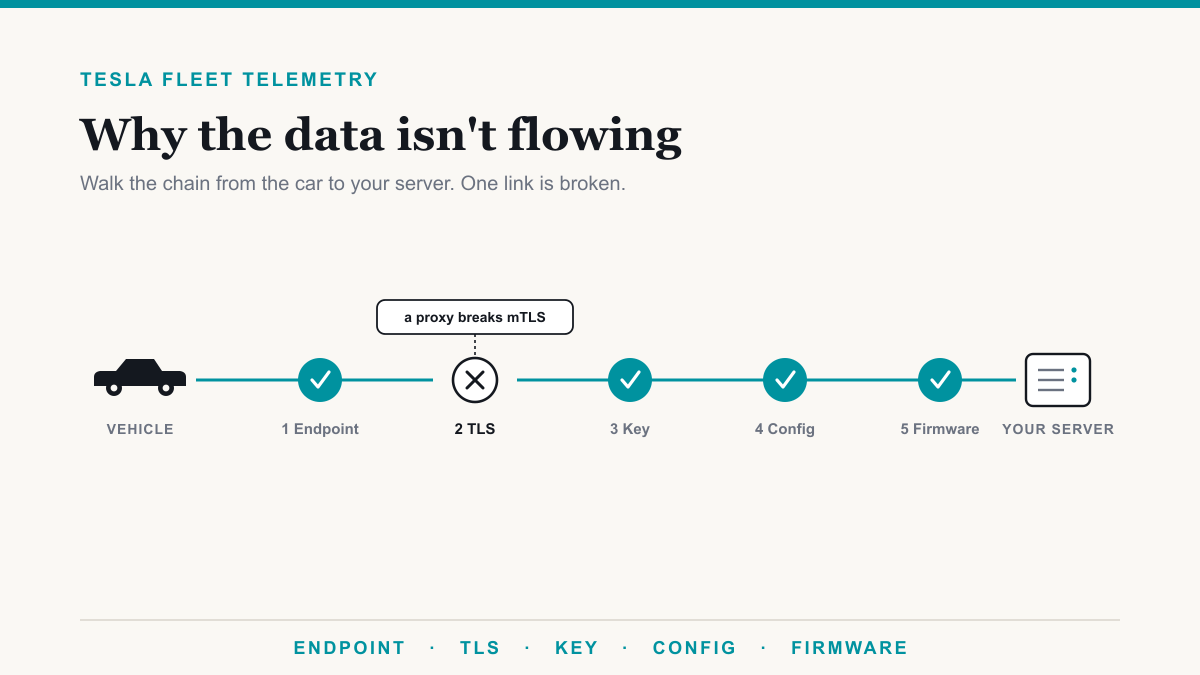
There is also a ceiling problem. Polling hundreds of vehicles on a tight schedule runs into rate limits, and you end up engineering queues and backoff logic just to stay under them, which is a lot of effort to make the expensive option barely work. Streaming sidesteps that entirely, which is why it is the right default for anything past a few cars. If your build is telemetry-only and needs near real time, streaming is not just cheaper, it is the only approach that actually meets the requirement. We get into the delivery side of that in getting Tesla telemetry into an on-prem platform, and if your streaming pipeline is set up but not producing data, the fix is usually one of the issues in why a Tesla Fleet Telemetry server isn't receiving data.
Frequently asked questions
How much does the Tesla Fleet API cost?
Tesla bills the Fleet API per use. Streaming telemetry runs about $0.00667 per vehicle-hour, while pulling the same data by polling the vehicle_data endpoint about once a minute runs about $0.12 per vehicle-hour. Commands and wake requests are billed separately, and each account gets a $10 monthly credit.
Is streaming or polling cheaper for a Tesla fleet?
Streaming is far cheaper, roughly eighteen times cheaper per vehicle-hour than polling at a one-minute interval. Streaming also bills only when a value changes, while polling charges for every request whether the data moved or not, so the gap widens further on vehicles that sit idle.
What is the $10 Tesla Fleet API credit?
Tesla gives each developer account a $10 monthly credit against Fleet API usage. It is enough to cover streaming, a few commands, and a couple of wakes for one or two vehicles, which suits a hobbyist. Across a real fleet it is a rounding error, not a meaningful discount.
How much would a 200-vehicle Tesla fleet cost to monitor?
Streaming a 200-vehicle fleet lands roughly in the hundreds of dollars a month, around $400 at about ten active hours per vehicle per day and under $1,000 even streaming around the clock. Polling the same fleet at a one-minute interval runs into the thousands, roughly $7,000 or more.
Why not just poll the Tesla API every minute?
Polling is far more expensive, it is not truly near real time, and it runs into rate limits at fleet scale. To get closer to real time you poll faster, which raises the cost proportionally. Streaming gives you second-level freshness at a fraction of the price, which is why fleets stream.
Making Tesla Fleet API pricing work in your favor
The short version of Tesla Fleet API pricing is that streaming wins on cost and on freshness at the same time, and for any fleet of real size polling is neither cheap enough nor fast enough to justify. Design around streaming, keep commands and wakes deliberate, and the monthly bill for even a few hundred vehicles stays reasonable and predictable. If you would like help sizing the cost for your own fleet or standing the streaming pipeline up so the numbers actually hold, Desert Lakes Solutions can walk it through with you. See how we deliver Tesla fleet data, or book a discovery call and we will price it against your fleet.